solarpanelsforcommercialbuildings Offices, retail, hotels and leisure Book a roof survey
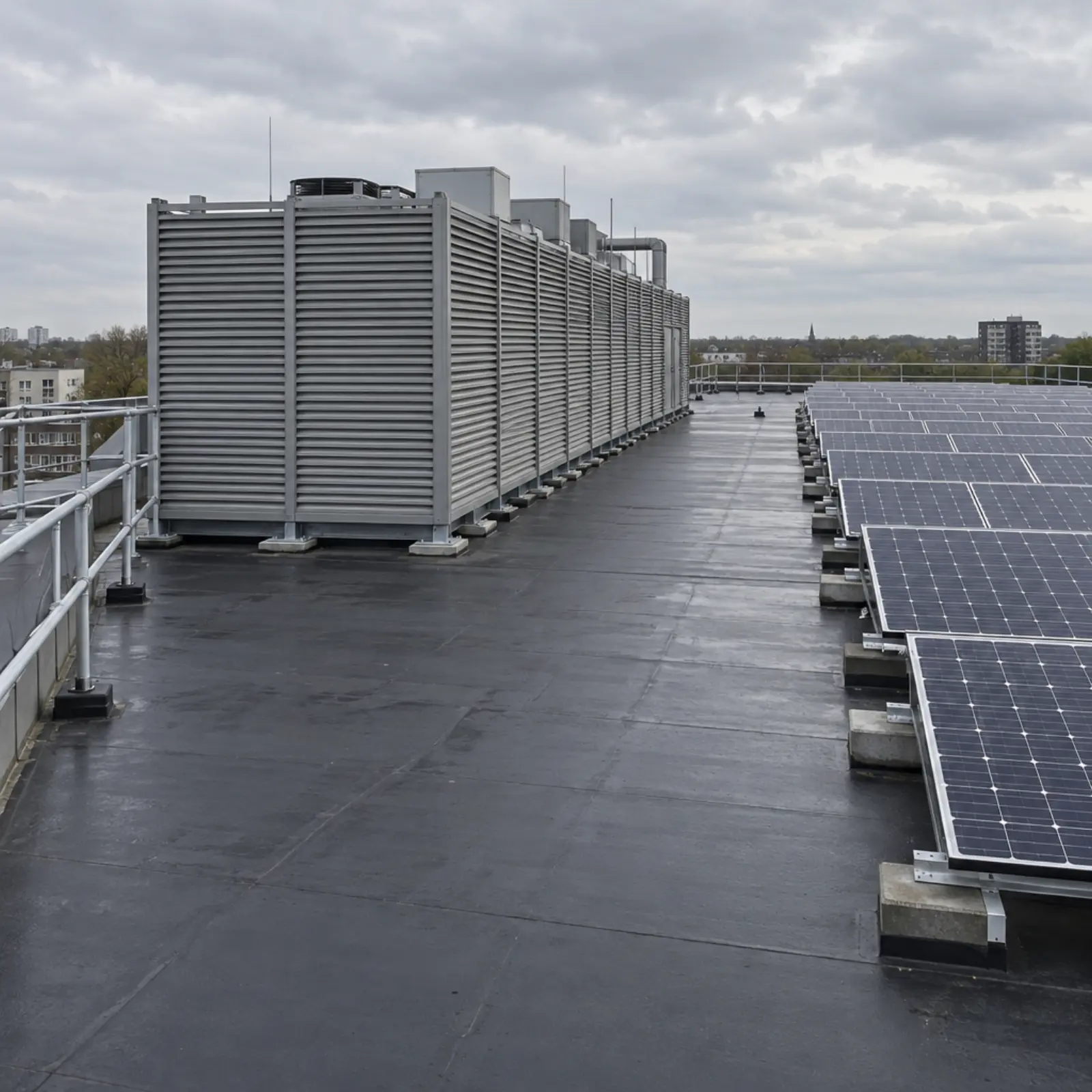
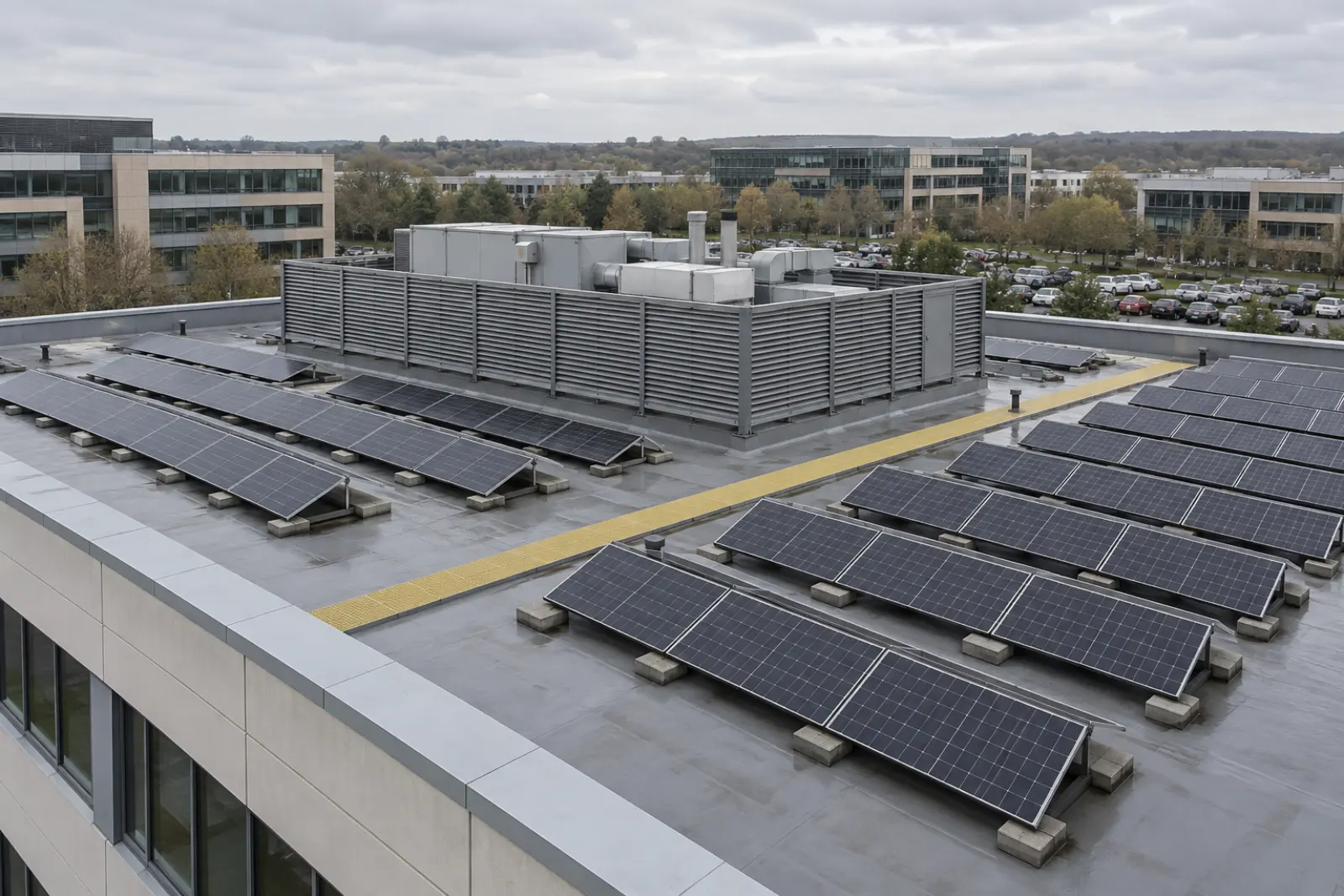
The flat roof of an office building on a business park, with a louvred plant screen and rows of low ballasted solar panels across the open roof around it

Offices, retail parks, supermarkets, hotels, leisure and let property

Solar panels for commercial buildings

We arrange the roof survey, the design and the grid application for rooftop solar on commercial buildings, and our MCS-certified partner carries out the installation. Free survey, no obligation, with the landlord and MEES questions answered before anything goes on the roof.

189
named commercial rooftop schemes on the planning record near the towns we cover
EPC B
proposed from 2031 for let buildings over 1,000 m², interim response of 18 June 2026
No cap
on rooftop solar under Class J permitted development in England since December 2023
886
kWh per kWp a year, mean modelled yield across 397 towns, EU PVGIS v5.2

Photograph: generated illustration, not a named site.

Sheet 01 Commercial rooftop solar, feasibility Illustrative, not to scale for construction
60 m 32 m N plant screen shade, kept clear stair core edge strip 1.5 m phase 1
Drawing Typical commercial roof
Roof 60 x 32 m, 1,920 m²
Array 209 kWp, east-west
Yield 185,000 kWh/yr
Scale 1:400 / Rev A

Illustrative layout for a flat commercial roof of this size, with plant, shade and access kept clear. Your own figures come from the roof survey.

Yield at 886 kWh per kWp, the mean of EU PVGIS v5.2 modelled figures for the 397 towns on this site.

What a commercial roof carries once the clutter is kept clear

  1. Plant screen and the strip of shade it throws are kept clear of panels.
  2. A 1.5 m edge strip stays free for edge protection and maintenance access.
  3. East-west ballasted frames sit on the membrane without piercing it.
  4. Phase 1, in blue, is the block a first price usually covers.
What the survey checks

Commercial rooftop solar is a photovoltaic array on the roof of a non-domestic building that supplies that building first and exports whatever it cannot use.

The panels are the easy part. What decides whether solar panels on a commercial building make sense is the roof (its covering, its structure, and what already sits on it), the lease (who owns the roof and who pays the electricity bill), and the shape of the building's demand across the day. This page is the map of those questions, with a page for each one in depth.

Why do commercial buildings suit rooftop solar?

Self-consumption is the share of an array's output that the building uses at the moment it is generated, and it is the number that decides the saving.

Every kWh of solar energy used on site replaces a kWh bought from your supplier at your unit rate, which carries network and policy costs as well as the energy itself. Every kWh exported earns an export tariff instead, which is usually worth less per kWh. So the buildings that suit commercial solar best are the ones whose demand for power sits under the generation curve: open in daylight, and open at weekends.

That is most commercial property. An office runs lighting, IT and cooling through the working day. A supermarket has refrigeration running around the clock and trading seven days. A hotel or leisure centre keeps laundry, kitchens, pool plant and ventilation going every day of the year. Fig. 1 draws the four shapes against the same generation curve.

The benefits for a business

For businesses, the benefits of commercial solar panels come down to four things: a lower energy bill for as long as the system runs, a share of the building's power produced at a cost fixed when the system is installed rather than by the wholesale market, lower reported emissions from purchased electricity, and, for a landlord, a better EPC rating on the building. Solar energy systems on commercial property are long-term assets, which is why the lease and the roof covering matter as much as the panels.

What happens to the surplus

Output the building cannot use flows to the grid. Under the Smart Export Guarantee, a scheme administered by Ofgem, suppliers pay for electricity exported from eligible installations up to 5 MW, including solar PV. Tariffs vary by supplier, and the business chooses which one to take. Where a lot would be exported, battery storage can move it into the evening instead, which is why storage is modelled rather than assumed.

Export
5 MW
Smart Export Guarantee cap for solar PV installations. Ofgem, SEG eligibility, checked 22 September 2026.
Measured, not assumed
The survey sets your half hourly consumption against modelled generation, so the used on site share is a figure for your building.
FIG. 1 One roof, four kinds of building
00:00 06:00 12:00 18:00 24:00
Office, weekday Demand sits inside the working day. At weekends it falls to base load (dotted) and more is exported.
00:00 06:00 12:00 18:00 24:00
Supermarket Refrigeration runs all night, so there is a floor under the whole curve every day of the week.
00:00 06:00 12:00 18:00 24:00
Hotel A morning and an evening peak either side of generation. The evening is where storage earns its keep.
00:00 06:00 12:00 18:00 24:00
Leisure centre with pool Pool plant keeps a steady load from early morning to late evening, seven days a week.
  • generation used in the building
  • generation exported
  • building demand
Illustrative shapes, not measured data. The same generation curve set against stylised demand for each building type: the fill is what the building uses, the hatching is what goes to export.

Which commercial buildings are solar panels planned for, and what are their roofs like?

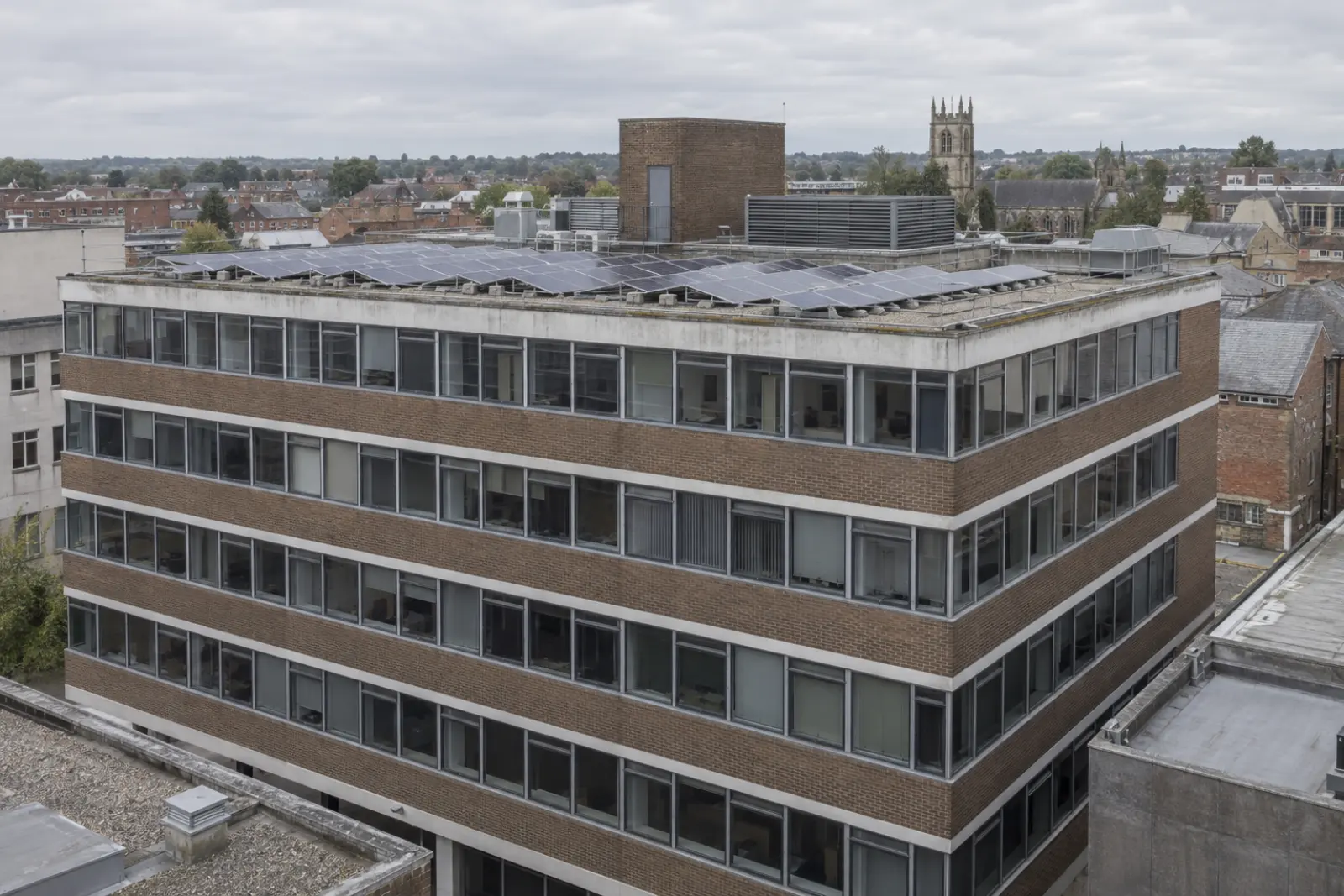
Some commercial buildings suit solar panels better than others, and each type brings its own roof and its own pattern of power use. Here is what the roof usually looks like on each, and how the building uses energy. The photographs are generated illustrations of the building types, not named sites.

A town centre office block whose flat roof carries a lift overrun, a plant screen and a solar array on low frames
Generated illustration, not a named site.

Office blocks and business parks

Demand: weekday, 08:00 to 18:00

A flat roof behind a parapet, shared with air handling units, a lift overrun, a stair core and often a cradle track for window cleaning. Plant and the shade it throws come out of the usable area first, so an office roof usually carries less panel than its footprint suggests.

Office demand for lighting, IT and cooling sits squarely in daylight hours, so a weekday array is mostly consumed in the building. The weekend is the weak point: base load only, and more of the output goes to export.

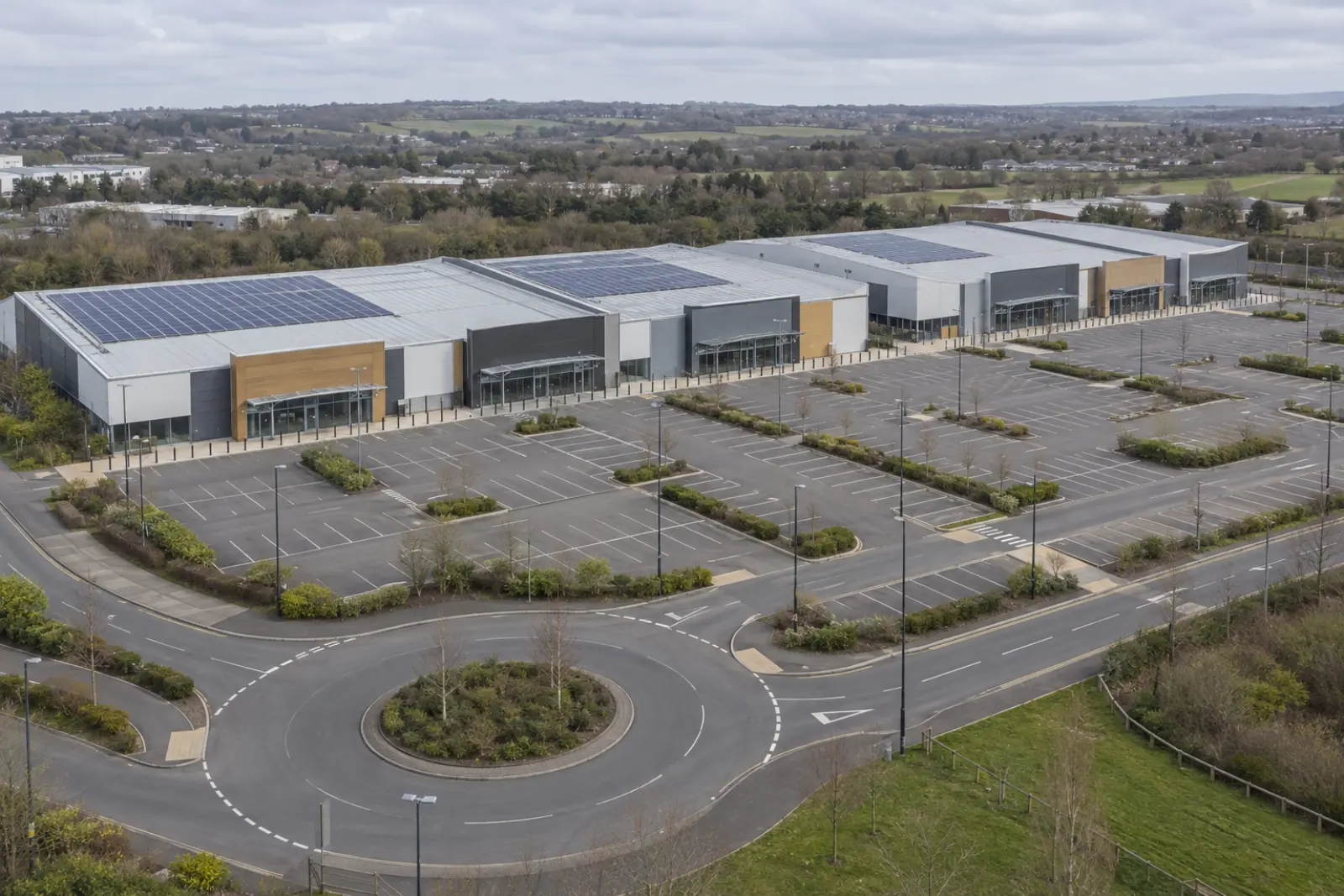
Aerial view of an out-of-town retail park where some of the large unit roofs carry solar arrays and others are bare
Generated illustration, not a named site.

Retail parks and retail units

Demand: seven days, trading hours

Large single storey units, commonly a profiled metal roof on a steel frame, sometimes with rooflights in a regular pattern. The roof is often the landlord's, the unit is the tenant's, and the lease decides who can touch it.

Trading hours run seven days, lighting and heating or cooling are on throughout, and the roofs are big and unshaded. The complication is ownership rather than engineering, which is why a lot of retail park schemes are put forward by the landlord.

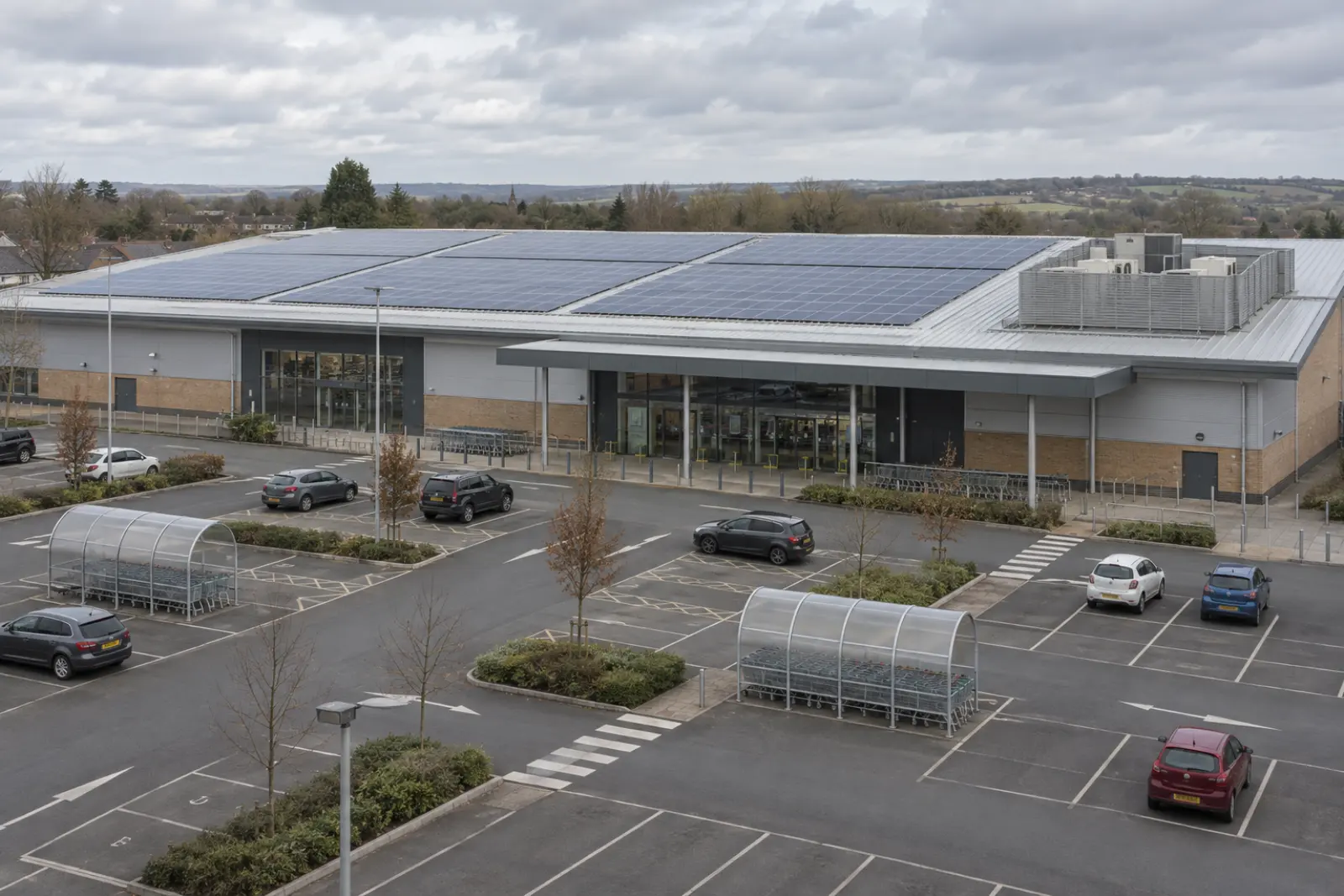
A supermarket roof almost entirely covered in solar panels, with screened refrigeration plant at one end and the car park in front
Generated illustration, not a named site.

Supermarkets and food stores

Demand: 24 hours, refrigeration base load

A wide roof with refrigeration condensers and plant screened at one end, frequently with a loading bay and a long clear run of roof across the sales floor.

Chilled and frozen cases run around the clock, so there is a large demand under the whole generation curve every day of the year. Very little of a well sized array goes to waste, which is the case supermarket operators have been making in planning applications.

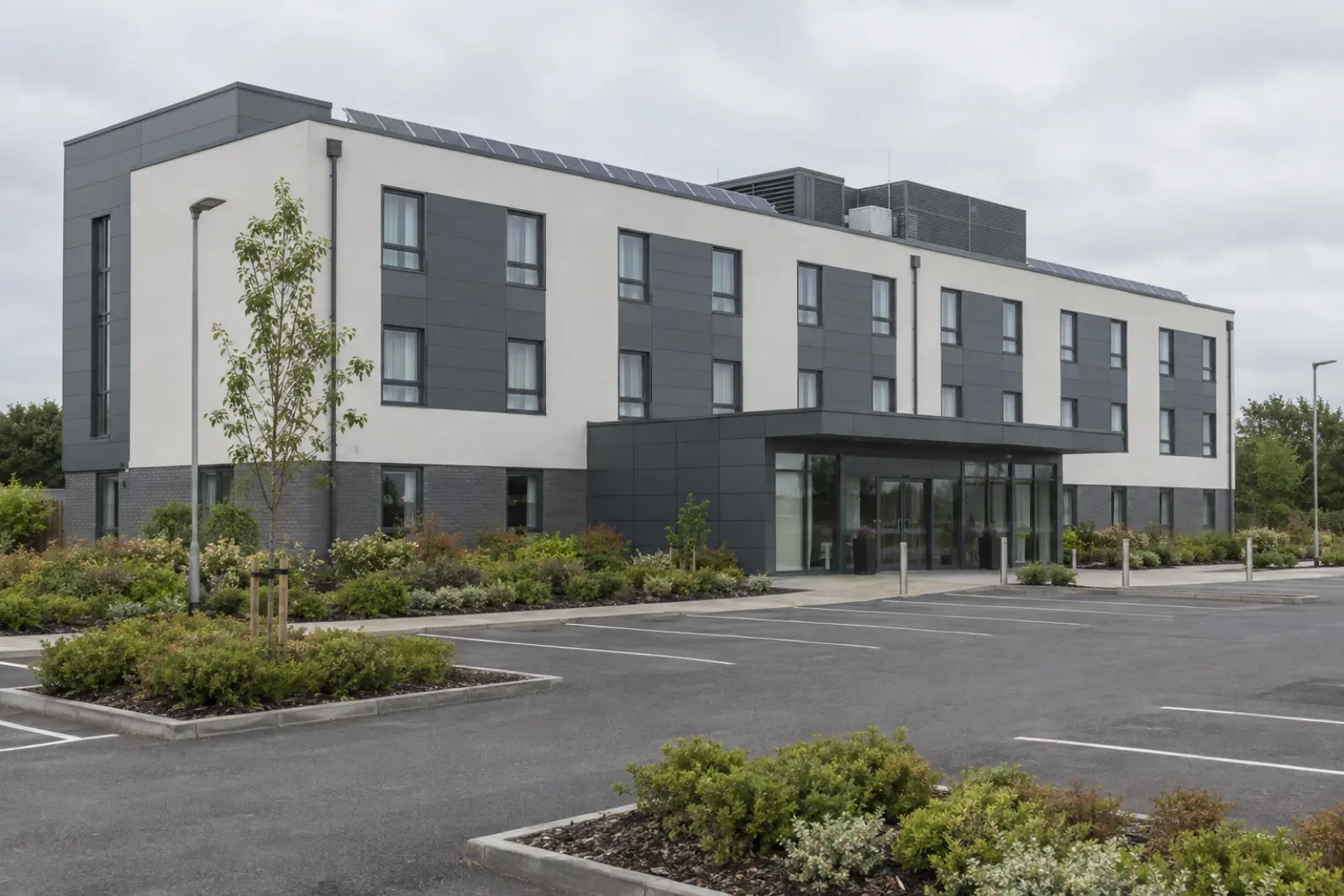
A three storey roadside hotel with a solar array on its flat roof beside the rooftop plant
Generated illustration, not a named site.

Hotels

Demand: seven days, morning and evening peaks

Three or four storeys, a flat roof crowded with extract fans, condensers and water tanks, and guest rooms directly below, which rules out noisy work at night and shapes when an installation can happen.

Laundry, kitchens, hot water and air conditioning keep a seven day daytime load, though the heaviest demand arrives in the evening after generation has fallen. Hotels are where battery storage is most often worth modelling.

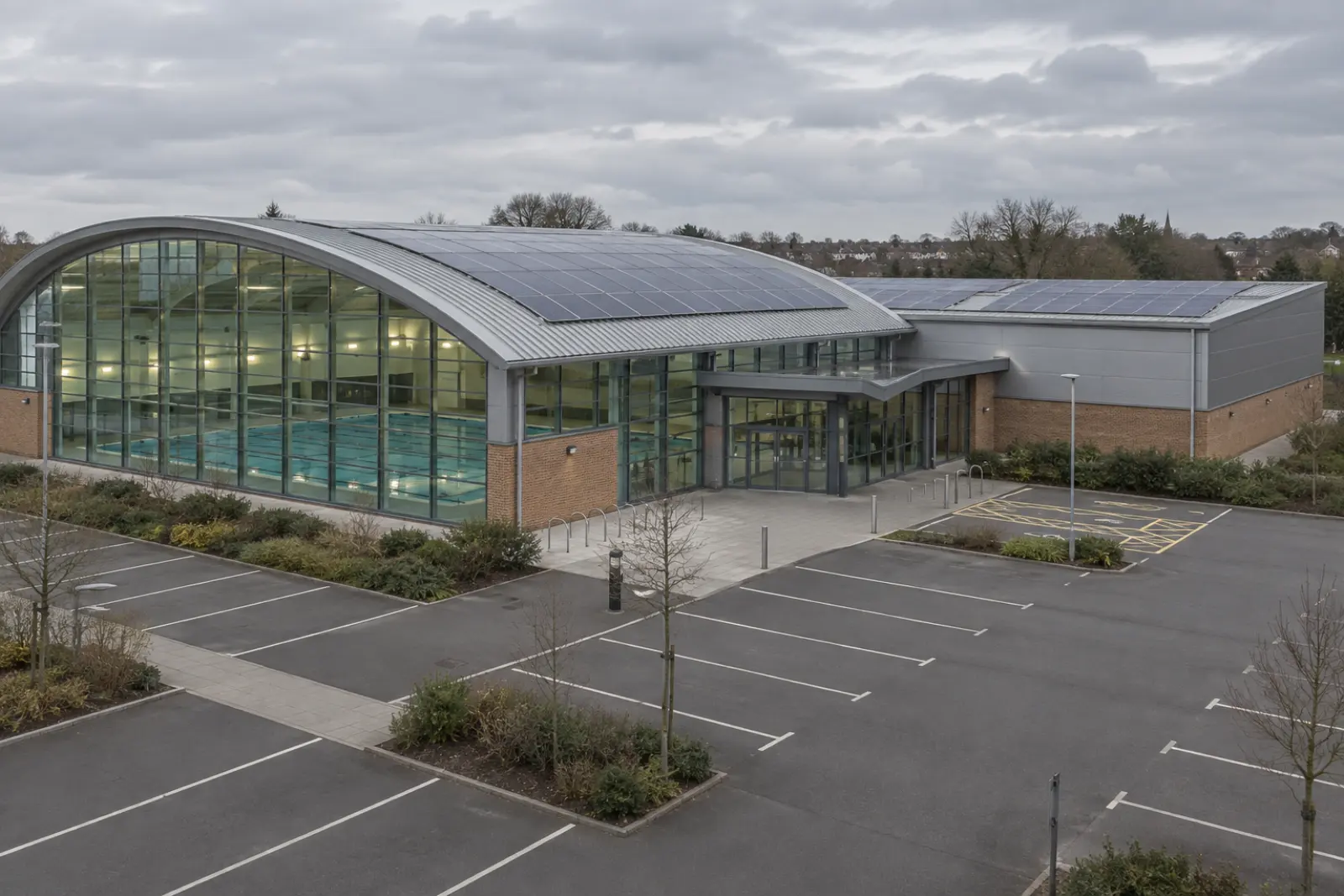
A leisure centre with solar panels across the pool hall roof and the lower sports hall block beside it
Generated illustration, not a named site.

Leisure centres, gyms and pools

Demand: seven days, 06:00 to 22:00

Typically two blocks: a tall pool hall, often a long span, and a lower sports hall or gym. The pool hall roof may need checking for condensation and corrosion before it takes extra load.

Pool filtration, heating, ventilation and dehumidification run all day, every day. That steady load makes leisure one of the strongest fits for rooftop solar, and the planning database has a run of health and racquet club schemes to show it.

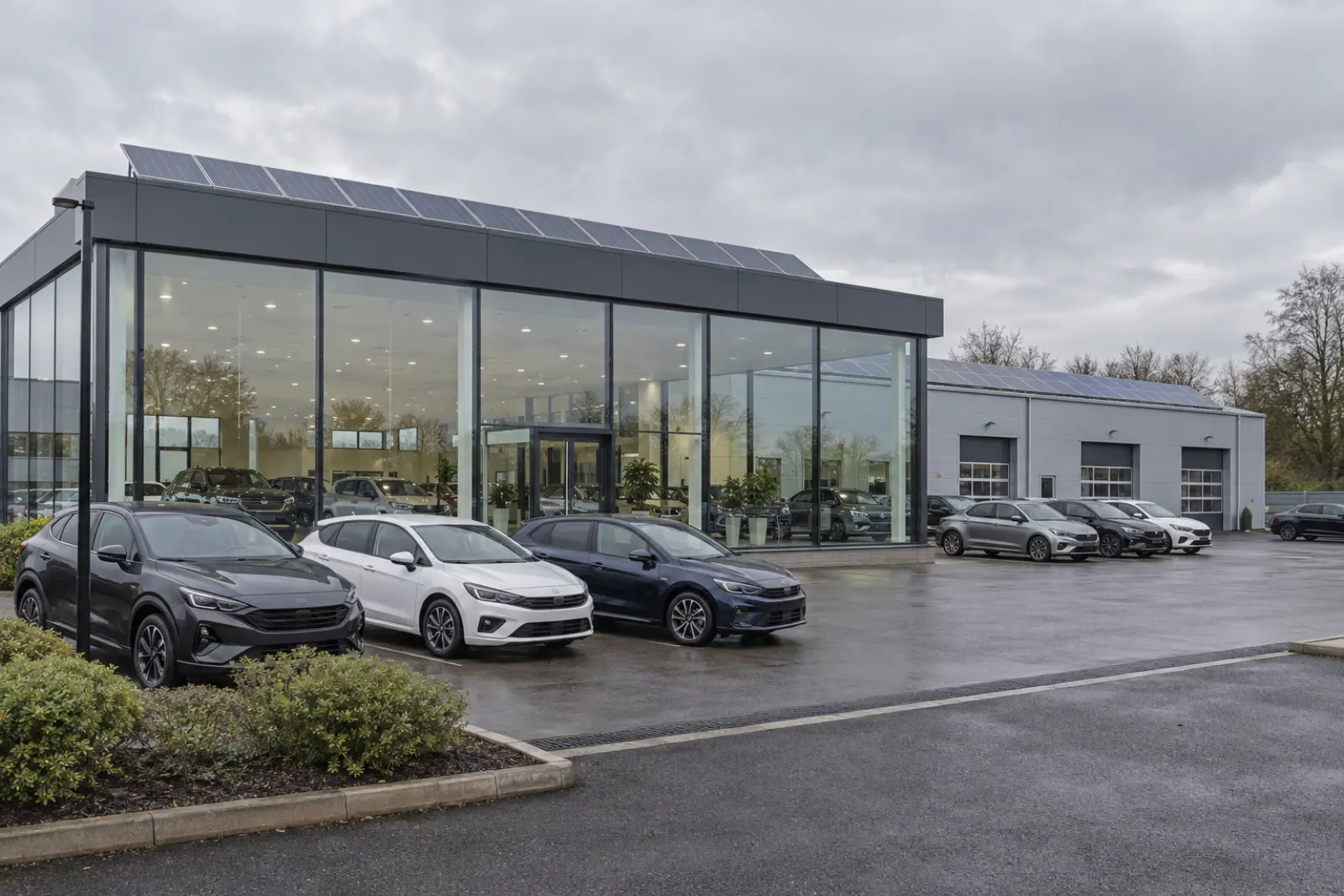
A car dealership showroom and workshop, both roofs carrying solar panels, with cars on the forecourt
Generated illustration, not a named site.

Car dealerships and showrooms

Demand: six or seven days, plus vehicle charging

A glazed showroom with a small flat or low pitch roof, and a larger workshop or prep bay behind it that usually carries most of the array.

Showroom lighting, workshop compressors and ramps, and increasingly the charging of electric stock and demonstrators. Vehicle charging can move a lot of demand into daylight hours if it is scheduled that way.

Multi-let commercial property

Demand: split across tenants

A building with several occupiers is the hardest case and often the most valuable one. The roof and structure are usually retained by the landlord, each tenant has its own supply and meter, and the landlord has no bill of its own to offset. A scheme can still work: the landlord funds the array, supplies the tenants through a private wire or a common landlord supply, and recovers the cost through an energy charge or a green lease clause.

It is also the arrangement that MEES pushes towards, because the EPC belongs to the building and the obligation to meet the minimum standard sits with the landlord.

How landlord led schemes are set up

Is commercial rooftop solar actually being built?

Yes. The Renewable Energy Planning Database lists 189 named rooftop schemes on commercial buildings near the 135 towns in our dataset that have one, and 162 of them have consent, are under construction or are operating.

These are other organisations' schemes, not ours: supermarket chains, health and racquet clubs, NHS trusts, retail park and business park owners. The Renewable Energy Planning Database (REPD) is the government's register of renewable projects that have been through the planning system. It tracks projects over 150 kW (the threshold was 1 MW until 2021), so smaller commercial arrays do not appear in it at all. The count is a floor, not a census.

Of these, 9 were put through planning by landlords and investment managers rather than occupiers, among them abrdn, Tristan Capital Partners, UREF LP, Invesco Real Estate and Extrams Property. That is the pattern the MEES changes point towards: the owner fits the array to protect the rating and the letting, and sells the power on to the tenant.

Every location page on this site lists the named schemes nearby, the office and retail stock of the local authority from the Valuation Office Agency, and a modelled yield for the town. Find your town.

Source
Renewable Energy Planning Database, Q1 2026, roof-mounted schemes on commercial buildings, deduplicated by scheme name and operator.
189
named commercial rooftop schemes in the dataset
162
of them consented, being built or operating
63
on supermarkets and retail
47
on leisure and hospitality buildings
Renewable Energy Planning Database, Q1 2026. Other organisations' schemes, counted across the towns this site covers.
FIG. 2 Named commercial rooftop schemes, by building and status
Supermarkets and retail 63 Leisure and hospitality 47 Hospitals, health and civic 46 Offices and business parks 28 Car dealerships 5
  • operational or under construction
  • consented, awaiting construction
  • application submitted
  • withdrawn or refused
The same figures as a table
Category operational or under constructionconsented, awaiting constructionapplication submittedwithdrawn or refused Total
Supermarkets and retail 55251 63
Leisure and hospitality 23861 47
Hospitals, health and civic 53056 46
Offices and business parks 32320 28
Car dealerships 0410 5
Counted across the towns on this site and deduplicated. Schemes of 150 kW or less are not listed, so the real number of commercial arrays is higher. Source: Renewable Energy Planning Database, Q1 2026

Who pays for commercial solar when the building is let?

On let commercial property the question is rarely whether the roof can take an array. It is who owns the roof, who pays the bill, and who is still there when the investment has paid back.

An owner-occupier pays and benefits, which keeps it simple. A tenant on a full repairing lease pays the electricity bill but usually needs the landlord's consent to alter the roof, and may not be in the building long enough to see the return. A landlord of a multi-let building owns the roof but has no bill of its own to offset. Each arrangement has a workable route.

Set-up Roof Electricity bill Usual route
Owner-occupier Yours Yours Buy outright or take a PPA. The simplest case: one party pays, one party benefits.
Single let, full repairing lease Landlord's, tenant repairs Tenant's Either the tenant funds it under a licence for alterations, or the landlord funds it and sells the power to the tenant. The break date and reinstatement clause decide which.
Multi-let, landlord retains the roof Landlord's Each tenant's Landlord led, supplying tenants through a landlord supply or private wire, with the charge set out in the lease or a side agreement.

How does rooftop solar affect MEES and the EPC rating?

MEES, the Minimum Energy Efficiency Standards, is the regulation that sets the lowest EPC rating at which a landlord may let non-domestic property in England and Wales.

Since 1 April 2023 a landlord may not continue to let a non-domestic building rated F or G unless a valid exemption is registered. On 18 June 2026 the government published its interim response on the next step: from 2031, let buildings over 1,000 m² must reach EPC B where it is cost effective, the proposed interim EPC C milestone for 2027 will not be taken forward, buildings under 1,000 m² stay at EPC E, and the seven year payback test and the exemptions remain. Legislation and guidance are to follow.

The response does not mention solar. What connects the two is how the rating is worked out: a non-domestic EPC is an asset rating calculated with the Simplified Building Energy Model (SBEM), and on-site renewable generation is part of that calculation. A rooftop array can therefore improve the rating, by an amount that depends on the building, so it should be modelled by an energy assessor alongside lighting, heating and controls before a landlord relies on it.

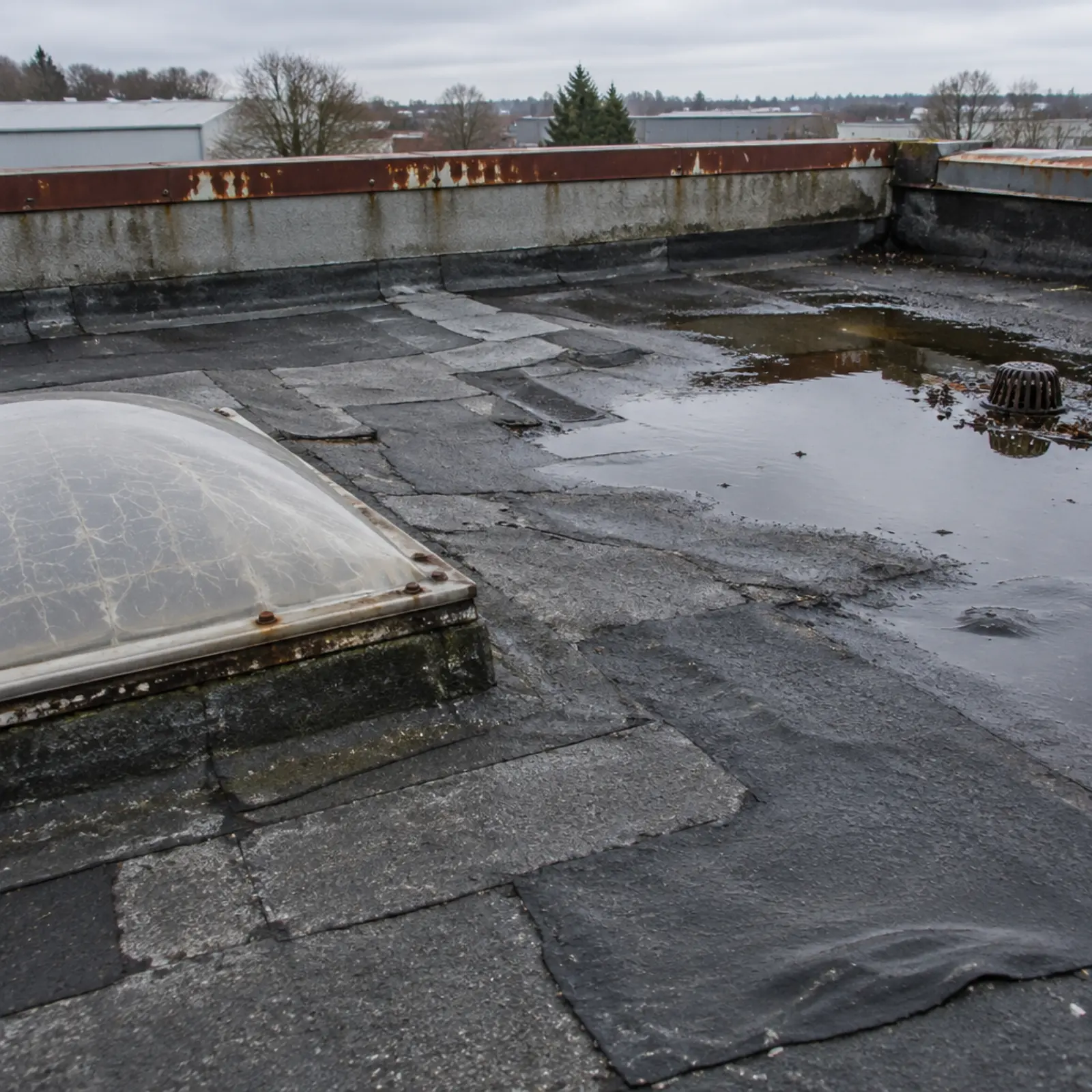
An ageing felt flat roof with patched repairs, blistering and ponding water near an outlet, and a crazed dome rooflight
Generated illustration, not a named site.
Over 1,000 m²
EPC B
From 2031, where cost effective. Interim government response, 18 June 2026.
Now
EPC E
Minimum to continue letting since 1 April 2023.
FIG. 3 The minimum rating for let non-domestic buildings
2018 2020 2022 2024 2026 2028 2030 2032 E 1 Apr 2018 E 1 Apr 2023 18 Jun 2026 B 2031
  1. 1 Apr 2018 New lets, renewals and extensions need EPC E or better
  2. 1 Apr 2023 Applies to every existing let too, unless an exemption is registered
  3. 18 Jun 2026 Interim response: the 2027 EPC C step is dropped
  4. 2031 Let buildings over 1,000 m² to reach EPC B, where cost effective
England and Wales. The 2031 step is dashed because the legislation to bring it in has not yet been laid. Source: gov.uk, MEES landlord guidance (updated 5 May 2026) and interim response (18 June 2026)

Do you need planning permission for solar panels on a commercial building?

In England, rooftop solar on a non-domestic building is usually permitted development under Class J of Part 14 of the General Permitted Development Order 2015, so no full planning application is needed. Above 50 kW, which covers most commercial arrays, the developer must first apply to the local planning authority for a determination on prior approval of the design and appearance, in particular glare on neighbouring land.

The capacity limit that used to apply, 1 MW, was removed from 21 December 2023. The limits that remain are physical. On a flat roof the highest part of the equipment must be no more than 1 m above the highest part of the roof, excluding chimneys; on a pitched roof it may project no more than 0.2 m beyond the roof plane; and nothing may sit within 1 m of the external edge of the roof. Class J does not cover listed buildings or their curtilage, or scheduled monuments, and in conservation areas the extra restriction applies to wall-mounted equipment facing a highway.

Panels must be sited to minimise their effect on the building's appearance, and removed when they are no longer needed. Wales and Scotland have their own permitted development rules, and building regulations on structure and fire apply wherever the building is.

Flat roof
1 m
Maximum height above the highest part of the roof, and minimum distance from its edge.
Capacity cap
none
Removed from 21 December 2023.

What drives the cost of commercial solar panels, and how can it be paid for?

We do not publish a price per kWp for commercial solar panels. On commercial buildings the roof, the access and the electrical work move the total further than the number of solar panels does, so a quotation is only worth having once the roof has been surveyed.

01

Usable area and array size

Design, scaffold or edge protection, the grid application and commissioning are costs a small array pays as well as a large one, so they weigh more heavily on a small roof.

02

Roof covering and mounting

Ballasted east-west frames on a membrane roof, rails clamped to profiled metal sheet, and hooks under slate or tile are priced very differently, and a membrane near the end of its life should be replaced before the array goes on.

03

Structure

Ballast adds dead load. A structural engineer checks the deck and frame, and strengthening, where it is needed, is a real cost.

04

Access and working hours

A town centre office with no crane position, a supermarket that must keep trading, or a hotel with guests below all change how long the job takes and when work can happen.

05

Electrical and grid work

Distance from the roof to the intake, spare capacity in the switchboard, and anything the network operator asks for under G99 before it will accept the export.

06

Storage and charging

Battery storage and vehicle charging are separate items that change the size of the job and the economics of the whole system.

Three ways businesses pay for commercial solar panels

Buy outright

The business owns the solar panels and keeps every kWh of energy they save. Solar panels sit in the special rate pool for capital allowances, and the Annual Investment Allowance, £1 million a year, can be set against qualifying spend.

What moves the cost

Power purchase agreement

A funder owns and maintains the array on your roof and sells you the electricity it generates at an agreed rate, usually under a long lease of the roof. No capital outlay, a lower saving, and a document your landlord or lender will want to read.

PPAs and let buildings

Grants and local funding

Grant funding for private commercial buildings, where it exists, tends to be local, time limited and sector specific, so we keep the current list on its own page rather than quoting it here.

What is open now

Tax and rates: solar panels are listed in the special rate pool on gov.uk's capital allowances guidance, and the Annual Investment Allowance is £1 million. In England, the Valuation for Rating (Plant and Machinery) (England) (Amendment) Regulations 2022 leave solar generating and storage plant out of the rateable value from 1 April 2022 for days before 1 April 2035. Take advice on how either applies to your business.

What happens at a commercial roof survey?

The survey is where the process of installing solar panels on a commercial building really starts. It is free, it does not commit you to anything, and it produces the numbers a board or a landlord will ask for.

We arrange it through our MCS-certified installation partner, and it is the same process whether you want to install solar panels on one office or across a retail park. The output is a layout drawn to your roof, a modelled yield for your postcode, the share of it your building would use, the structural and grid position, and a price.

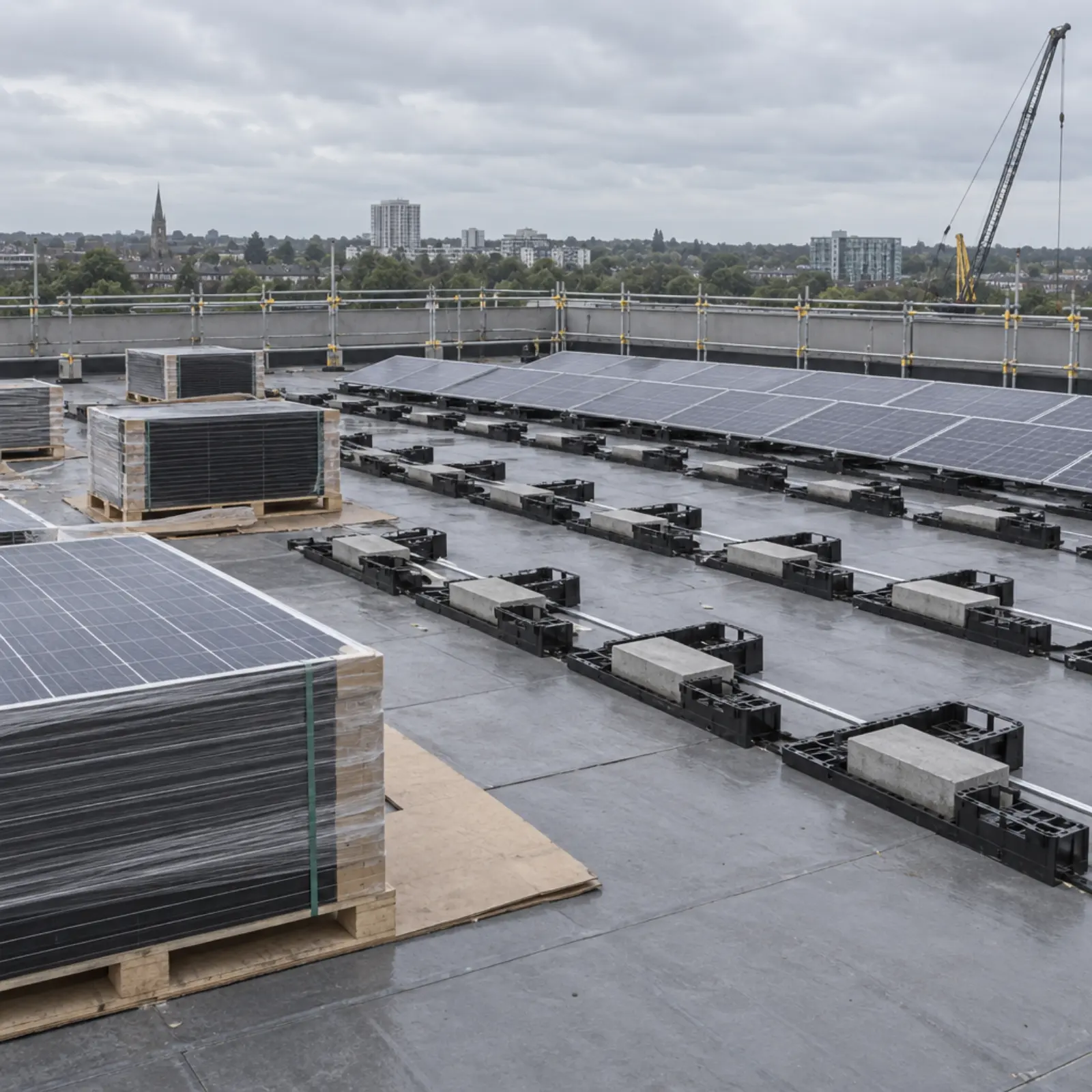
An installation underway on a flat commercial roof: panels staged on boards, ballast trays laid out, one section of array complete, edge protection in place
Generated illustration, not a named site.
Grid
G99
Connection route for anything above 3.68 kW per phase, applied for through your local network operator.
  1. 01

    Desk review

    Before anyone decides to install solar panels: half hourly consumption data, the current EPC, roof drawings if they exist, and the lease. Most of the answer about who should fund the array is in the lease.

  2. 02

    On the roof

    Covering and remaining life, deck and parapet, plant, shade, access and edge protection. In a building of the right age we check the asbestos register before anyone lifts a panel.

  3. 03

    Design and yield

    A panel layout that keeps plant, shade and access clear, modelled generation for your postcode, and the share of it your own load would use.

  4. 04

    Grid application

    The G99 application to your network operator, submitted early because it is usually the longest wait in the programme.

  5. 05

    Installation and handover

    The solar panel installation is carried out by our MCS-certified installation partner, then commissioned, certified, and registered for an export tariff.

After the panel installation is handed over, the long-term work is monitoring and maintenance: a system that reports its generation, so a tripped inverter shows up in days, and periodic inspection of the panels, fixings, cabling and roof around them. The walkways and edge strip in the drawing at the top of this page are there so that maintenance can be done safely for the long term.

Book a free roof survey for your commercial building

Send the postcode and tell us what the building is and whether it is let. We come back with what the roof can take, what it would generate against your demand, and the funding routes that fit the lease.

No survey fee and no obligation. Lenzie Consulting Ltd (company 08174104) arranges the survey and passes your details to our MCS-certified installation partner so they can design and quote.

We pass your details to our MCS-certified installation partner so they can quote. Read the privacy notice.

Questions about solar panels on commercial buildings

How much does a commercial solar panel system cost?
The cost of a commercial solar panel installation depends on the usable roof area, the roof covering and how the panels are fixed, whether the structure needs checking or strengthening, access and working hours, and the electrical and grid work needed to connect it. We do not publish a price per kWp, because on commercial buildings those factors move the total more than the number of solar panels does. A roof survey produces a priced design for your building, and our cost page explains each driver.
Do you need planning permission for solar panels on commercial buildings?
In England usually not. Rooftop solar on non-domestic buildings is permitted development under Class J of Part 14 of the General Permitted Development Order 2015, with no capacity limit since 21 December 2023, provided the panels stay within the height and edge limits and the building is not listed or a scheduled monument. Above 50 kW, which covers most commercial arrays, the developer must first apply to the local planning authority for a determination on prior approval of the design and appearance, in particular glare on neighbouring land. Wales and Scotland have their own rules, and building regulations still apply everywhere.
What is the average cost of a commercial solar panel?
The solar panel itself is one line in a commercial quotation, alongside mounting, inverters, cabling, access, design, the grid application and commissioning. An average price per panel says very little about what a particular roof will cost, which is why we price the whole system after a survey rather than quoting per panel.
Are commercial solar panels worth it?
For businesses that use most of their energy in daylight, seven days a week, they usually are. That means supermarkets, leisure centres, hotels and retail. Offices do well on weekdays and export more at weekends. The answer for a particular building turns on how much of the output is used on site, how long you will own or occupy it, how much life the roof covering has left, and who pays the electricity bill. The survey measures the first against your half hourly data.
Can a tenant put solar panels on a building they lease?
Usually only with the landlord's consent, because installing solar panels is an alteration to the roof, and most commercial leases restrict alterations. A licence for alterations typically sets out who owns the array, who insures and maintains it, and whether it is removed at the end of the lease. In multi-let buildings the roof is commonly retained by the landlord, so a landlord led scheme is often the practical route.
Does solar improve a commercial EPC rating?
It can. On-site renewable generation is part of the SBEM calculation behind a non-domestic EPC, so a rooftop array can improve the rating. How much depends on the building, so have an energy assessor model it before relying on it for MEES.
Is battery storage worth adding to a commercial array?
Battery storage earns its place where demand peaks after generation has fallen, such as hotel evenings or leisure centre late sessions, or where an office would otherwise export much of its weekend output. Where the building already uses nearly everything the roof produces during the day, a battery adds cost without adding much saving.
Do you pay business rates on rooftop solar panels?
In England, regulations made in 2022 leave solar generating and storage plant out of the rateable value until 1 April 2035. The position differs in Wales and Scotland, so check with your rating adviser there.
What maintenance does a commercial solar array need?
Periodic visual and electrical inspection, cleaning where soiling builds up, monitoring so a fault shows up in days rather than at the next bill, and an inverter replacement at some point in the system's long-term life. On a flat roof the walkways and edge protection laid out at design stage are what make that maintenance safe.
Sources

All checked 22 September 2026.