solarpanelsforcommercialbuildings Offices, retail, hotels and leisure Book a roof survey

What your roof can carry, and what it would make

A commercial solar calculator converts roof area into array size and array size into generation. This one uses the modelled yield for your own town rather than a national average, because the difference across the country is about 46 percent and that is too large to average away.

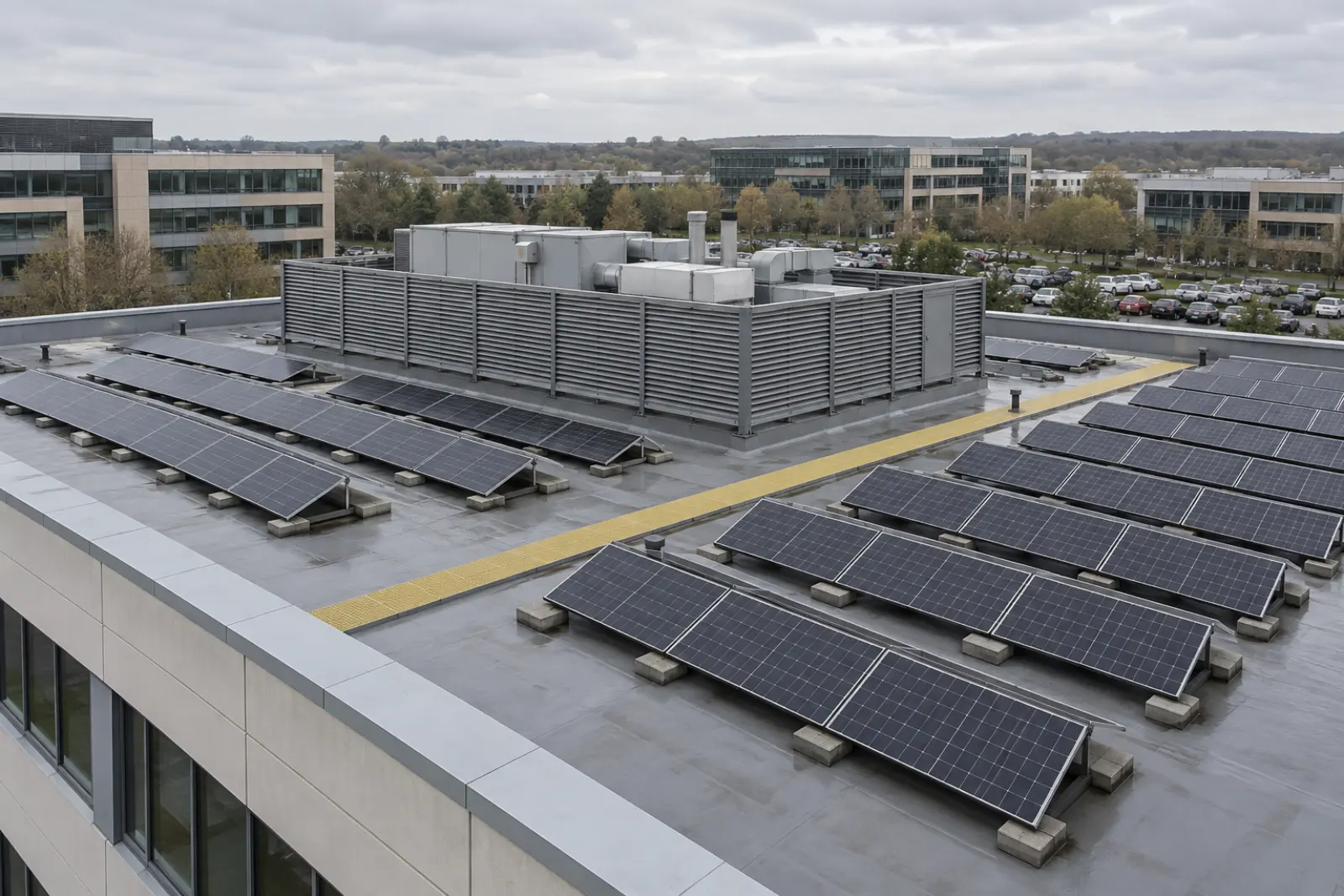
The flat roof of an office building on a business park, with a louvred plant screen and rows of low ballasted solar panels across the open roof around it
Usable area is what is left once the edge strip, plant and walkways come out. Generated illustration, not a named site.

Modelled yield for this town, EU PVGIS v5.2

The whole roof. Deductions come next.

62%

What is left once the edge strip, plant and its shade, rooflights and walkways come out.

Sets a starting share of generation used on site rather than exported. The survey replaces it with your half-hourly data.

p/kWh

From your bill, the delivered day rate. Leave blank to see kWh only.

p/kWh

Smart Export Guarantee rates vary by supplier.

FROM YOUR INPUTS Reading, 907 kWh per kWp
Usable roof 1,240 m²
Array that fits 253 kWp
Modelled generation 230,000 kWh a year
Used on site 138,000 kWh
Exported 91,800 kWh

Modelled from the figures you entered, at the yield for that town. It is arithmetic, not a quotation: the roof survey replaces every line of it with measured numbers.

Book a roof survey

What the numbers mean

Array size

A kWp, or kilowatt peak, is the rated output of an array under standard test conditions, and it is the unit a quotation is priced against. A panel occupies roughly 2.2 square metres and carries about 0.45 kWp, so a kWp needs roughly 4.9 square metres and usable area divided by 4.9 is the array the roof will take.

Modelled generation

Annual generation is the array size multiplied by the yield for your location. Yield here comes from EU PVGIS v5.2 for a south-facing array at a 10 degree tilt with a 14 percent system loss. An east-west layout on a flat roof yields a little less per kWp but fits more kWp on the same roof, so the survey models both.

The split

Self-consumption is the share of generation you use on site instead of exporting, and it is what decides the payback. An office, a store and a hotel use their roof's output in very different shapes, so the occupancy patterns in the calculator are starting points; the survey measures it from twelve months of your own half-hourly data.

The money line

The value shown uses the unit rate you enter, from your own bill. We publish no price per kWp and no assumed tariff, because both move with the roof and the market. Export income depends on the Smart Export Guarantee rate your supplier offers.

Questions about the calculator

How accurate is a commercial solar calculator?
A calculator is arithmetic, not a survey. This one is accurate about the things it can know, which are the yield for your latitude and the way area converts into array size. It cannot know what load your roof deck takes, how many years the membrane has left, how much shade the plant screen and the building next door throw, or what your network operator will allow you to export, and those are what decide a real scheme. Treat the output as a sense check that tells you whether a survey is worth booking.
Why does the yield change when I change town?
Modelled yield is the electricity a one kWp array produces in a year at that latitude and climate, and across the towns we cover it runs from 704 to 1028 kWh per kWp. That spread is about 46 percent, so the same array on the same roof earns materially more in one place than another. Figures come from EU PVGIS v5.2, and every location page shows the number for that town.
How much of the roof is usable?
Usable area is the gross roof minus the edge strip, plant and the shade it throws, rooflights, smoke vents, walkways and anything else in the way. On a single storey retail box with little plant it can be three quarters of the roof. On an office block with a lift overrun, a plant screen and a tall parapet it can be under half. The slider is there because it is the input that moves the answer most, and the survey replaces the guess with a measured layout.
What share of the generation will a commercial building use itself?
It depends on when the building is occupied and how big the array is against the load. An office uses almost everything a modest array makes on a weekday and exports much of the weekend's generation. A supermarket running refrigeration all day uses nearly all of it. Hotels and leisure centres sit in between, with weekend and evening load. The patterns in the calculator are starting points only; the survey measures it from twelve months of half-hourly data.
Why does the calculator not show a price?
The price of a commercial array moves with roof condition, access to an occupied building, the mounting system, the grid application and the state of the market on the day. Any number we published here would be a guess dressed as a quotation. What the calculator does instead is give you the generation, and the value of that generation at a unit rate you supply from your own bill, so every figure in the money line is one you can check.
Next: what drives the cost, what the survey covers, or the yield for every town we cover across 48 counties. The mean across them is 886 kWh per kWp.