Planning permission for solar panels on commercial buildings
Most rooftop arrays on offices, shops, hotels and leisure buildings in England need no planning application at all. They are permitted development under Class J, provided they keep inside three measurements and stay off listed buildings. This page sets out the rule in full from the legislation, what changed in December 2023, where prior approval still applies, and the consents that planning does not cover, so that a landlord, an occupier or a lender can see exactly where a building stands.
Contents
Do you need planning permission for solar panels on a commercial building?
Permitted development is a grant of planning permission made nationally by the General Permitted Development Order, so development that falls inside it needs no planning application to the local planning authority.
For solar panels mounted on a non-domestic building in England, the relevant grant is Class J of Part 14 of the Town and Country Planning (General Permitted Development) (England) Order 2015. It covers any building other than a dwellinghouse or a block of flats, which takes in the office, the retail unit, the supermarket, the hotel, the gym, the car showroom and the let multi-tenant building alike. A block of flats, in the Order's own definition, is a building consisting wholly of flats, so a parade of shops with flats above sits in a grey area worth confirming in writing.
The honest short answer, then, is that for solar panels mounted on a non-domestic building you usually do not need planning permission, but you do need to check four things before you rely on that: the building's listed status, the geometry of the array, whether permitted development rights have been removed for the site, and the size of the system.
- The panels go on the roof of an office, shop, hotel, gym or other non-domestic building in England
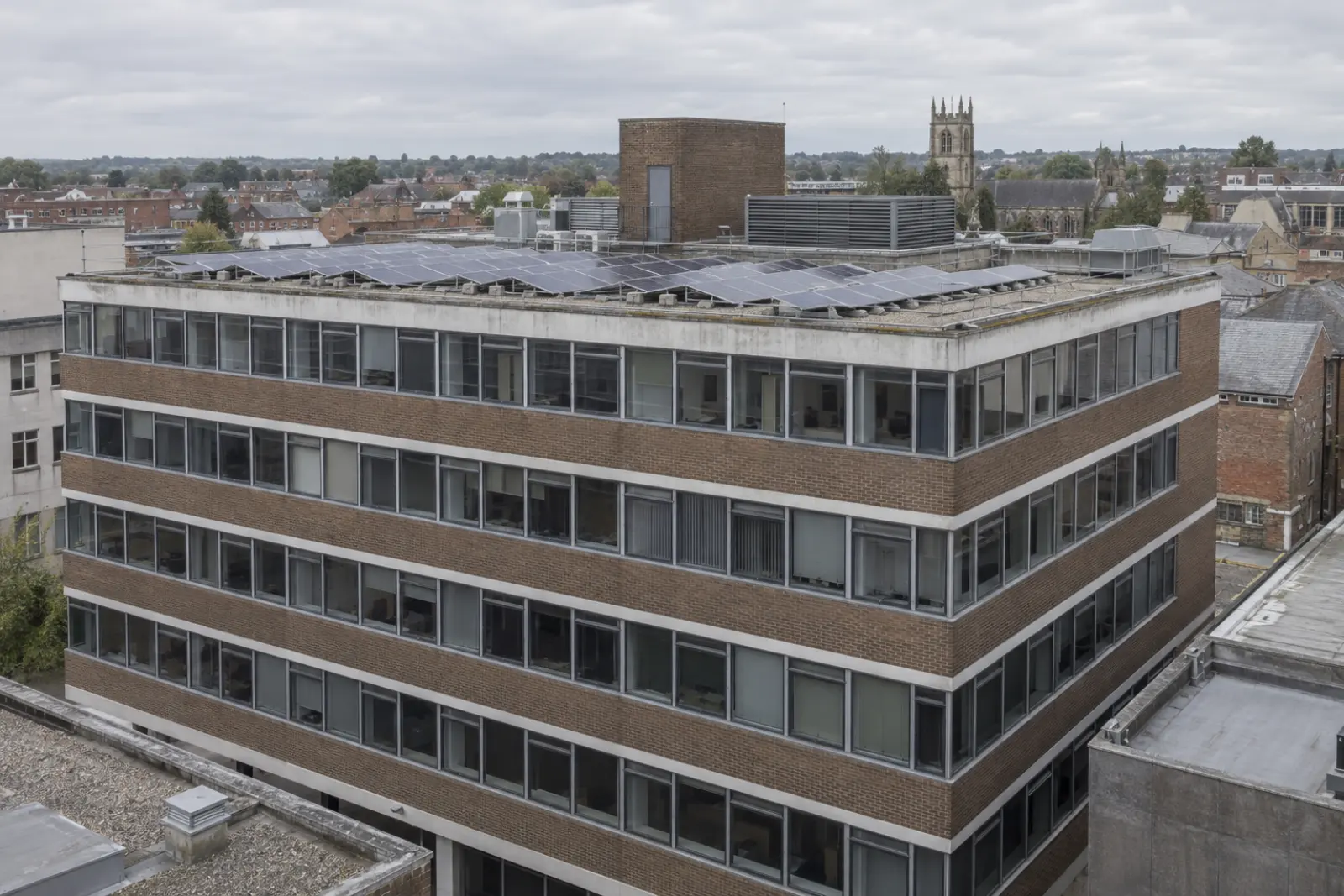
- They sit within the Class J geometry: 0.2 m off a pitched roof, 1 m above a flat roof, 1 m back from the edge
- The building is not listed and not in the curtilage of a listed building or on a scheduled monument
- The array is 50 kW or less, or, above 50 kW, the council has dealt with a prior approval request
- The building is listed, where listed building consent is also needed for works affecting its character
- Any part of the array breaks the height or edge limits, however small the breach
- An article 4 direction or a condition on an earlier permission has removed permitted development rights
- The panels go on a canopy over parking or on the ground, which other classes cover with their own rules
What Class J allows on a non-domestic roof
Class J is the permitted development right in England for the installation, alteration or replacement of solar PV and solar thermal equipment on buildings other than dwellinghouses and blocks of flats.
It grants three things: microgeneration solar thermal equipment on a building, microgeneration solar PV equipment on a building, and other solar PV equipment on the roof of a building. Microgeneration has the meaning in section 82 of the Energy Act 2004, which for electricity is plant with a capacity of 50 kilowatts or less. The split matters, because an array above 50 kW is only permitted on the roof, and it carries a prior approval step that a smaller one does not.
The limits on the roof
Development is not permitted by Class J if the equipment would:
- Pitched roof. Protrude more than 0.2 metres beyond the plane of the roof slope, measured from the perpendicular with the external surface of the slope.
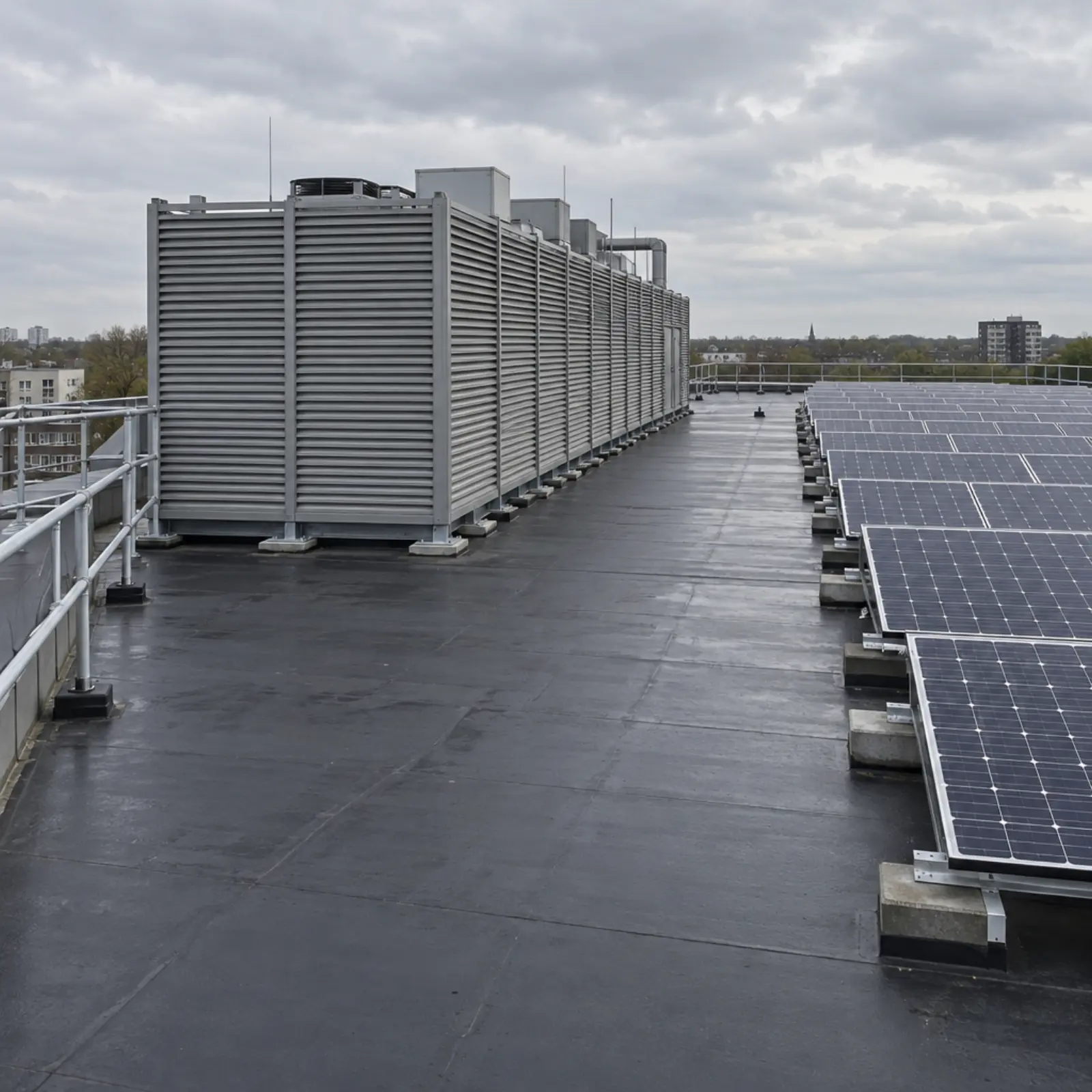
- Flat roof. Have its highest part more than 1 metre above the highest part of the roof, excluding any chimney. On a roof with a parapet, a lift overrun or a plant deck, what counts as the highest part is worth settling with the council before the frames are chosen.
- Edge. Be installed on a roof within 1 metre of the external edge of that roof.
- Scheduled monument. Be installed on a site designated as a scheduled monument.
- Listed building. Be installed on a listed building or on a building within the curtilage of a listed building.
Panels on walls
Wall-mounted panels are allowed only as microgeneration. They may not protrude more than 0.2 metres beyond the plane of the wall, may not sit within 1 metre of "a junction of that wall with another wall or with the roof of the building", in the Order's words, and on article 2(3) land may not go on a wall which fronts a highway. A wall-mounted array above 50 kW is outside Class J and needs a planning application.
The two conditions that always apply
Every commercial solar installation under Class J is permitted subject to two conditions: the equipment must, so far as practicable, be sited to minimise its effect on the external appearance of the building and the amenity of the area, and it must be removed as soon as reasonably practicable when no longer needed. The first is the condition most often ignored on a street-facing roof. The second belongs in any lease or roof licence.
A. Flat roof
J.1(b) and J.1(c). No part of the equipment higher than 1 m above the highest part of the roof, chimneys excluded, and nothing within 1 m of the roof's external edge.
B. Pitched roof
J.1(a) and J.1(c). No more than 0.2 m beyond the plane of the roof slope, and nothing within 1 m of the roof's external edge. The projection is exaggerated here so it can be seen.
C. Wall, microgeneration only
J.2. Wall mounting is permitted for microgeneration (up to 50 kW) only, and not on a wall fronting a highway on article 2(3) land.
Prior approval above 50 kW
Prior approval is a procedure in which the local planning authority decides whether it needs to approve specified details of development that is already permitted, without reopening the principle of it.
For solar PV on the roof above 50 kW, the developer must apply, before starting, for a determination as to whether prior approval is required for the design or external appearance of the development, in particular the impact of glare on occupiers of neighbouring land. The application is a written description, a site plan showing the proposal, contact details and the fee. The council publicises it by a site notice for at least 21 days or by notice to adjoining owners and occupiers, takes account of representations, and has regard to the National Planning Policy Framework so far as relevant to design and appearance.
Work may begin once the council says prior approval is not required, once it gives approval, or once 56 days have passed from receipt without a decision being notified. The development is then carried out in line with what was approved or, where no approval was needed, with what was submitted. So the drawings that go in are the drawings you build. For a retail park next to housing or a hotel below a residential tower, a short glare assessment with the submission is what stops the question becoming a refusal.
What changed in December 2023, and since
The Town and Country Planning (General Permitted Development etc.) (England) (Amendment) (No. 2) Order 2023 came into force on 21 December 2023 and widened the rights for non-domestic solar in England in four ways.
First, it removed paragraph J.3, the rule that stopped a Class J(c) array exceeding 1 megawatt. There is now no capacity ceiling on a non-domestic roof, only the geometry and the prior approval step above 50 kW. Second, it removed paragraph J.1(d), which had barred panels on a roof slope fronting a highway on article 2(3) land. A street-facing roof in a conservation area is now within Class J, though the wall rule remains. Third, it inserted Class OA, the first permitted development right for solar canopies over non-domestic parking. Fourth, it relaxed Class K for ground-mounted panels on article 2(3) land.
Two later changes are worth knowing. From 25 April 2024 the time limit for enforcement against unauthorised building operations in England became ten years rather than four. And on 9 April 2026 a further amending order trimmed the wording of the National Planning Policy Framework reference in the prior approval test at J.4(8), without altering the limits on the roof.
- 15 Apr 2015 England GPDO 2015 in force. Class J lets non-microgeneration PV go on a non-domestic roof up to 1 MW, with prior approval above 50 kW. S.I. 2015/596
- 1 Apr 2019 Wales The 50 kW output threshold for non-domestic solar in Part 43 is removed. A 3 km airport and aerodrome exclusion and a glint and glare condition are added. S.I. 2019/330
- 21 Dec 2023 England The 1 MW cap (J.3) goes, as does the bar on roof slopes fronting a highway on article 2(3) land (J.1(d)). Class OA solar canopies over non-domestic parking arrive, and Class K ground-mounted limits change. S.I. 2023/1279
- 25 Apr 2024 England The enforcement time limit for unauthorised building operations rises from four years to ten, for breaches completed on or after this date. Levelling-up and Regeneration Act 2023, s.115
- 24 May 2024 Scotland A new Class 6J for solar on non-domestic buildings, with no output limit and a single 1 m projection rule. S.S.I. 2024/102
Listed buildings, conservation areas and other protected places
Article 2(3) land is the set of designations in Schedule 1 of the 2015 Order where some permitted development rights are narrower: conservation areas, areas of outstanding natural beauty (now branded National Landscapes), land specified under section 41(3) of the Wildlife and Countryside Act 1981, the Broads, National Parks and World Heritage Sites.
Listed buildings
Class J does not apply to a listed building, or to any building within its curtilage, so panels need a planning application. Separately, listed building consent is required for any works of alteration that would affect the character of the building as one of special architectural or historic interest, and fixing an array to it will almost always do so. The two are applied for together. A town centre office in a listed terrace, or a hotel in a converted historic building, falls here. The curtilage point catches more buildings than people expect: a modern extension, a detached store or a service building within the grounds of a listed hotel is outside Class J too.
Conservation areas
A conservation area is article 2(3) land, and since December 2023 the only additional Class J restriction there is the bar on panels on a wall fronting a highway. Roof panels in a conservation area are otherwise permitted on the same terms as anywhere else, though above 50 kW the council's view on design and appearance at prior approval will be informed by the designation. Many conservation areas also carry an article 4 direction, which can remove permitted development rights; your local planning authority keeps the list.
World Heritage Sites, National Parks and National Landscapes
These are article 2(3) land too, and in England they are treated for roof panels exactly as a conservation area is. That is not true in Scotland, where Class 6J does not apply at all within a World Heritage Site or a National Park.
Scheduled monuments
Class J excludes a site designated as a scheduled monument. Works on one need scheduled monument consent under the Ancient Monuments and Archaeological Areas Act 1979, which is a separate regime from planning. It is rare on a commercial roof, but it does arise on town centre sites built over archaeology.
Car park canopies and ground-mounted panels are not Class J
A solar canopy, in Part 14, is a canopy structure installed with solar PV or solar thermal equipment and open on all sides or, where it adjoins a building, on three sides.
Class J covers equipment on a building. A canopy over customer parking at a retail park, a dealership forecourt or a hotel car park is a structure in its own right, and since 21 December 2023 it has had its own right under Class OA, for a solar canopy within an area lawfully used as off-street parking other than for a dwellinghouse or a block of flats.
Class OA is not permitted if any part of the development exceeds 4 metres in height above ground level, is within 10 metres of the curtilage of a dwellinghouse or a block of flats, is on a scheduled monument or within the curtilage of a listed building, displays an advertisement, or sits on parking that exists only under the temporary use right. Unlike roof panels, every Class OA canopy needs a prior approval application covering siting, design and external appearance, in particular glare on neighbouring premises, and on article 2(3) land the canopy's appearance on that land. Over a permeable surface, run-off from the canopy has to be directed to a permeable area. The canopy must be completed within three years of the prior approval, and removed, with the land restored, when no longer needed.
Stand alone solar on the ground within the curtilage of a non-domestic building falls under Class K, which is limited to microgeneration, one installation per curtilage, 9 square metres of panel, 3 metres in any dimension, 4 metres high and 5 metres from the boundary. It is sized for a small array beside a building, not for a car park. Wales has a near identical stand alone solar panel allowance in Part 43, Class B, with the same 9 square metre ceiling.
How the rules differ in Wales and Scotland
Planning is devolved, so Wales and Scotland each run their own General Permitted Development Order, and solar panels on commercial buildings are treated differently in each.
Wales and Scotland both allow unlimited-output rooftop solar on non-domestic buildings without an application. Wales has done so since 1 April 2019, a change that took out the 50 kW threshold, and Scotland since 24 May 2024. Neither has an equivalent of England's prior approval step above 50 kW, so a large array on an ordinary roof can be simpler there. What they add instead are exclusions: both remove the right within 3 km of an airport or aerodrome, which in Scotland also covers technical sites; Wales keeps the bar on roof slopes fronting a highway on designated land that England dropped; and Scotland switches the right off entirely in National Parks, National Scenic Areas, historic gardens and designed landscapes, and World Heritage Sites.
| Rule | England | Wales | Scotland |
|---|---|---|---|
| Legislation | GPDO 2015, Schedule 2, Part 14, Class J | GPDO 1995 as it applies in Wales, Schedule 2, Part 43, Class A | GPDO (Scotland) 1992, Schedule 1, Part 1B, Class 6J |
| Output limit | None since 21 December 2023; prior approval above 50 kW | None since 1 April 2019 | None since 24 May 2024 |
| Pitched roof | 0.2 m beyond the roof slope | 20 cm beyond the roof slope | 1 m from the surface of the building |
| Flat roof | 1 m above the highest part of the roof, chimneys excluded | 1 m above the plane of the roof | 1 m from the surface of the building |
| Roof edge | Not within 1 m of the external edge | Not within 1 m of the external edge | No edge distance in the class |
| Walls | Microgeneration only (50 kW or less), 0.2 m, 1 m from junctions | Permitted, 20 cm, 1 m from junctions | Permitted within the 1 m projection |
| Designated land | Article 2(3) land: no panels on a wall fronting a highway | Article 1(5) land and World Heritage Sites: no panels on a wall or roof slope fronting a highway | Conservation area: not on the principal elevation or a side elevation fronting a road. Excluded entirely in National Parks, National Scenic Areas, historic gardens and designed landscapes, and World Heritage Sites |
| Listed buildings | Excluded, including buildings in the curtilage | Excluded on a building in the curtilage; for the listed building itself, listed building consent applies and gov.wales guidance treats it as excluded | Excluded, including the curtilage |
| Airports | No aerodrome exclusion in Class J | Excluded within 3 km of the perimeter of an airport or aerodrome | Excluded within 3 km of an aerodrome or technical site |
| Glare | Assessed at prior approval above 50 kW | Condition: sited to minimise glint and glare | No glare condition in the class |
| Car park canopies | Class OA, with prior approval, 4 m high, 10 m from homes | No equivalent class found in Part 43 | Class 9M, 4 m high, not in conservation areas |
| Enforcement time limit | 10 years for operations completed on or after 25 April 2024 | 4 years | 4 years, as the 1997 Act stands today |
Sources, all on legislation.gov.uk and checked 22 September 2026: England, Part 14 Class J; Wales, Part 43 Class A; Scotland, Part 1B Class 6J; Scotland, Part 2I Class 9M; enforcement limits in s.171B of the 1990 Act and s.124 of the Scottish 1997 Act. Wording is paraphrased; read the class itself before relying on a borderline case. Northern Ireland has a separate regime not covered here.
Which consent route applies to your building?
For a commercial building in England, the consent route follows from six questions asked in order, and the first one you answer yes to decides it.
- 01
Is the building listed, or within the curtilage of a listed building?
if yes Planning permission, and listed building consent for works that affect its character. Class J does not apply.
Class J, J.1(f); Planning (Listed Buildings and Conservation Areas) Act 1990
- 02
Is the site a scheduled monument?
if yes Planning permission and scheduled monument consent from the Secretary of State, through Historic England.
Class J, J.1(e); Ancient Monuments and Archaeological Areas Act 1979
- 03
Has an article 4 direction or a condition on an earlier permission removed permitted development rights?
if yes A planning application. Check the planning history and ask the authority before you design.
GPDO 2015, articles 3 and 4
- 04
Is it a canopy over parking, or panels on the ground rather than on the building?
if yes Not Class J. A canopy uses Class OA with prior approval; ground-mounted panels use Class K, with tight limits.
Part 14, Classes K and OA
- 05
Would any part break the Class J geometry: more than 0.2 m off a pitched roof, more than 1 m above a flat roof, or within 1 m of the edge?
if yes A planning application, or a redesign that brings the array inside the limits.
Class J, J.1(a) to (c)
- 06
Is the array larger than 50 kW, or does it include panels on a wall?
if yes Over 50 kW on the roof: apply for a prior approval determination on design, external appearance and glare, 56 days. Wall panels are permitted only as microgeneration, up to 50 kW.
Class J(c), J.2 and J.4(2); Energy Act 2004, s.82
- OK
None of the above
Permitted development under Class J, subject to its two conditions: site the panels to minimise their effect on the building's appearance and the area's amenity, and remove them when no longer needed. A Lawful Development Certificate confirms it in writing.
Class J, J.4(1); Town and Country Planning Act 1990, s.192
Why a Lawful Development Certificate is worth having
A Lawful Development Certificate for a proposed development is a formal decision by the local planning authority, under section 192 of the Town and Country Planning Act 1990, that the work described would be lawful if carried out.
Permitted development needs no certificate, so this is optional. It is still the document that answers the people who will ask. A funder taking security over the building, a buyer's solicitor raising enquiries, an insurer underwriting the roof and an incoming tenant all want evidence that the array was lawful, and "we read Class J" is not evidence. A certificate issued before the install fixes the position for the described scheme, and it settles the borderline questions, such as the highest part of a roof with a parapet or whether a shop with flats above counts as a block of flats, before money is spent.
For a landlord installing across a portfolio, a certificate per building is a small cost against the value of a clean title pack at sale or refinance. Above 50 kW, the prior approval determination does much the same job, because it is itself a written decision on the scheme. In Wales the same section 192 applies; in Scotland the equivalent is a certificate of lawfulness of proposed use or development under section 151 of the 1997 Act.
What planning permission does not cover
Planning decides whether a development may be built; it does not decide whether the roof can carry it, whether the lease allows it, whether the network will connect it, or whether the insurer will cover it.
Building regulations
Building regulations will normally apply to solar panels on a roof. The roof's ability to carry the added dead load and the wind uplift has to be checked and proven, and some strengthening may be needed; fire protection and weatherproofing are within the regulations too. That means a structural assessment of the deck and frame, and an application to building control or a registered building control approver. It is the step most often confused with planning, because planning control and building control are separate regimes run by different teams, and a commercial solar scheme can clear one and still be required to satisfy the other.
Landlord and lease consent
On let commercial property the roof is usually retained by the landlord, and an occupier needs a licence for alterations whatever the planning position. Terms to agree include roof access, insurance, the removal condition and who owns the equipment at lease end. A landlord fitting an array and selling the power to tenants needs the leases or a separate agreement to say so. The landlords page covers the structures, and the MEES page covers why landlords are looking at the roof at all.
The grid connection
Any system above 3.68 kW per phase connects under Engineering Recommendation G99 through the local distribution network operator, which sets what can be exported and when. For most commercial solar schemes the G99 application, not planning, is the longest wait in the programme, so we submit it early.
The insurer
RC62, Recommendations for fire safety with photovoltaic panel installations, is the joint code of practice published by RISCAuthority with the Microgeneration Certification Scheme and Solar Energy UK, updated in February 2023 and aimed at commercial and industrial rooftop arrays. Property insurers use it when underwriting a roof with panels on it, and it covers the design, installation and maintenance of solar panel installations rather than their planning status. Share the design with the building's insurer before contract, not after.
That is the order we work in. The roof survey measures the roof and its edges, identifies plant, parapets and anything listed nearby, and produces a layout that sits inside Class J, or tells you plainly where it does not. We arrange the survey, the design, the planning check, the G99 application and the installation through our MCS-certified partner. The calculator gives a first view of what the roof could generate, and the cost page sets out what drives the price. Figures for your area are on the locations pages.
Lenzie Consulting Ltd is not a firm of solicitors or planning consultants and this page is not legal advice. It summarises the legislation as published on legislation.gov.uk on 22 September 2026. For a listed building, a site with a planning history, or any borderline case, take advice or apply for a Lawful Development Certificate.
Find out whether your roof sits inside Class J
Send the postcode and the rough roof area. We come back with a survey date, and the survey produces a layout checked against the height and edge limits, the listed status of the building and the prior approval threshold.
No survey fee and no obligation to proceed.
Questions about planning and commercial solar
- Can you put solar panels on commercial buildings without planning permission?
- In most cases, yes. In England, solar panels on the roof of a non-domestic building are permitted development under Class J of Part 14 of the General Permitted Development Order 2015, which is a national grant of planning permission that needs no application. The panels must stay within three limits: no more than 0.2 m beyond a pitched roof slope, no more than 1 m above the highest part of a flat roof, and nothing within 1 m of the roof's external edge. The building must not be listed or in the curtilage of a listed building, and the site must not be a scheduled monument. Above 50 kW you ask the council whether it wants to approve the design, external appearance and glare before you start. Wales and Scotland run their own versions with different limits.
- What is the 20% rule for solar panels?
- There is no 20% rule in UK planning law. Nothing in Class J in England, Part 43 in Wales or Class 6J in Scotland limits how much of a roof panels may cover, and none of them sets a percentage of anything. Online, the phrase is mostly used for a system sizing habit, generating about a fifth more than you consume to allow for dull weather, which is a design choice and not a rule. The nearest real figure in the English legislation is 0.2 m: the most a panel on a pitched roof may project beyond the roof slope. If someone tells you the 20% rule limits your array, ask which regulation they mean.
- Does the 4 year rule apply to commercial property?
- It used to, and in England it no longer does for new work. The four year rule was the time limit after which a council could not take enforcement action against a breach of planning control consisting of building operations carried out without planning permission, and it applied to commercial and residential property alike. The Levelling-up and Regeneration Act 2023 changed section 171B of the Town and Country Planning Act 1990 so that, in England, the limit is ten years for operations substantially completed on or after 25 April 2024. Operations completed before that date keep the old four year limit. In Wales the four year limit still applies, and in Scotland section 124 of the 1997 Act still says four years. Immunity is a defence, not a consent, and waiting it out is not a plan any lender or buyer will accept; a Lawful Development Certificate is.
- How many solar panels can I have without planning permission?
- On a commercial building there is no longer a panel count or capacity ceiling in any of the three nations of Great Britain. England removed its 1 MW cap on 21 December 2023, Wales removed its 50 kW threshold on 1 April 2019, and Scotland's Class 6J has carried no output limit since 24 May 2024. What limits the array is geometry and location: the height and edge distances, the listed status of the building, and designated land. In England an array above 50 kW still needs a prior approval determination from the council before work starts, which is a 56 day process rather than a full application.
- Do I need planning permission for solar panels on a commercial building in a conservation area?
- In England, usually not, for roof panels. A conservation area is article 2(3) land, and since 21 December 2023 the only extra Class J restriction on that land is that panels may not go on a wall fronting a highway. Roof slopes facing the street are no longer excluded. Above 50 kW the council considers design and appearance at prior approval. Wales still excludes a wall or roof slope fronting a highway in a conservation area, and Scotland excludes the principal elevation and any side elevation fronting a road. Check for an article 4 direction, which some conservation areas carry.
- Is prior approval the same as planning permission?
- No. Prior approval is a narrower process in which the local planning authority decides only whether it needs to approve specified details of development that is already permitted. For roof panels above 50 kW in England, those details are the design and external appearance, in particular glare on neighbouring occupiers. The principle of the development cannot be refused on other grounds. The council has 56 days, it must publicise the proposal, and if it has not replied by the end of that period the development may go ahead in line with the details submitted.
- Do I need planning permission for solar panels on a commercial building in Wales?
- Usually not. Part 43, Class A of the General Permitted Development Order 1995 as it applies in Wales permits solar on the roof or wall of a non-domestic building with no output limit since 1 April 2019. The limits are 20 cm beyond a wall or pitched roof, 1 m above a flat roof, 1 m back from the roof edge and 1 m from wall junctions. It does not apply within 3 km of the perimeter of an airport or aerodrome, on a building in the curtilage of a listed building, on a scheduled monument, or on a wall or roof slope fronting a highway in a conservation area, National Park, AONB or World Heritage Site. Panels must be sited to minimise glint and glare.
- Does a tenant need the landlord's consent as well as planning?
- Almost always. Permitted development answers whether the council needs to give permission. It says nothing about whether the lease allows alterations to the roof, which is usually demised to the landlord or kept as common parts in a multi-let building. Expect a licence for alterations, with terms on roof access, insurance, removal at the end of the term and who owns the equipment. Where a landlord fits panels and sells the power to tenants, the lease or a separate agreement needs to say so. Our landlords page sets out the common structures.