Green leases and solar panels on let commercial property
On a let building the roof, the lease and the EPC belong to the landlord, and the electricity bill belongs to the tenant. That is why rooftop solar on offices, retail parks, hotels and other let commercial property stalls more often on paper than on the roof. This page explains what a green lease is under the Better Buildings Partnership Green Lease Toolkit, how the split incentive works, and the four structures that do get arrays built, with who funds, who owns the kit, who keeps the savings and which documents each one needs.
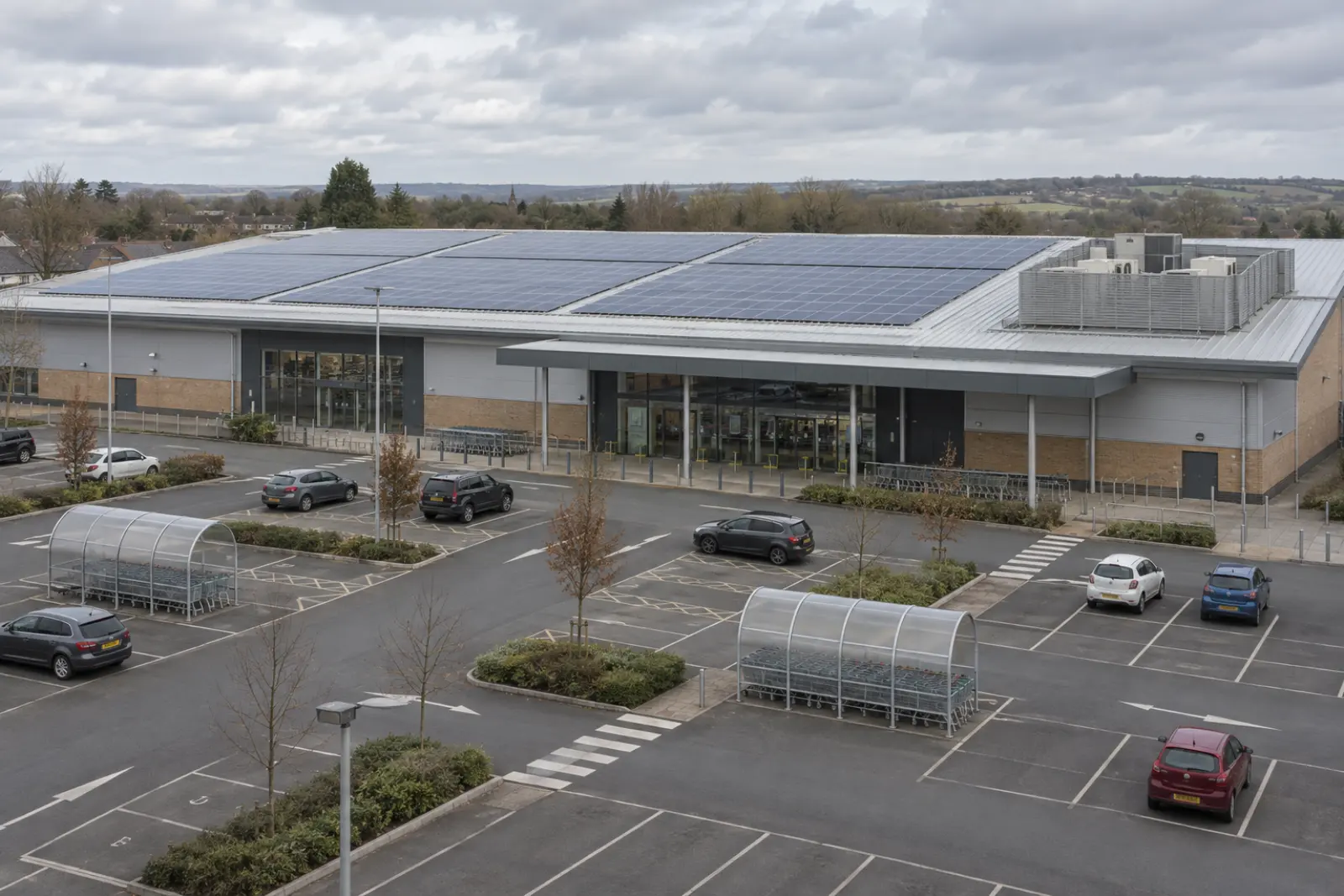
What is a green lease?
A green lease is a commercial lease that contains green lease clauses: provisions under which the landlord and the tenant agree to cooperate on the environmental performance of the building they share, from energy data to renewable energy.
Nothing in UK law defines green leases or requires one. The term describes the content of the lease, not a separate type of lease, and green leases range from a single cooperation clause to a set of binding obligations with measurable targets. What gives the market a common language is the BBP Green Lease Toolkit, published by the Better Buildings Partnership, a group of commercial property owners working on the sustainability of the built environment. The first version dates from 2008. The current edition was published on 29 January 2024, written for owners, occupiers, managing agents and lawyers across real estate.
Light, medium and dark green clauses
For most topics the 2024 toolkit offers three strengths of drafting, and parties pick between light, medium and dark green clauses according to how mature their sustainability commitments are. Light green drafting is largely cooperative and aspirational. Medium green drafting turns cooperation into practical obligations. Dark green drafting is the most demanding, binding one or both parties to specific outcomes. Much legal commentary, including the Law Society's guide to drafting green leases, still describes the range as light green to dark green, with medium as the newer middle step.
The renewable energy clause shows the difference well. The light green version requires each party to buy on a green tariff where one is available at a commercially reasonable rate. The medium green version requires a green supplier. The dark green version requires electricity to come first from equipment on the premises capable of generating renewable energy, then from a PPA with a renewable project developer, and only then from a green supplier. The toolkit's guidance note adds that parties should consider amending the roof and airspace rights so that generating equipment can actually be installed, which is the exact point where rooftop solar on let property usually gets stuck.
Green Lease Essentials
The toolkit also sets out Green Lease Essentials, ten areas the BBP would expect a lease to cover before it can credibly be called green: cooperation, a building management or sustainability group, sustainable use, data sharing and metering, extending the landlord's right to do works, tenant's alterations, EPCs, waste, reinstatement (yield up), and renewable energy. Four of those ten decide whether a solar array can go on a let roof at all: alterations, landlord's works, metering and renewable energy.
What are the benefits of green leases for landlords and tenants?
The benefit of green leases is that they give landlords and tenants a contractual way to deal with the environmental impact of a building neither party controls alone.
The built environment is a large source of carbon emissions, and on let commercial property much of the operational energy use sits with the occupier, behind meters the landlord may never see. Without green lease clauses, the landlord cannot get the data it needs for its EPC, its ESG reporting or its climate change targets, and the tenant cannot make sustainable improvements to a building it does not own. Green leases turn that into agreed work: shared data, a building management group, and consent for works that improve environmental performance.
For real estate owners and investment managers the case is about value as well as the environment. In the commercial property market an EPC rating bears directly on value, because under MEES a building below the minimum cannot continue to be let without an exemption, and properties with no path to a better rating face the 2031 trajectory with that risk unpriced. The 2024 toolkit also adds clauses on social impact and on circular economy principles for landlord and tenant works, including construction and fit out, which reflects how far green leases now reach beyond energy. The financial benefits for tenants are more direct: lower bills where the lease lets a solar project happen, and evidence for their own reporting. None of that needs dark green drafting on day one. A light green lease that shares data and permits works is often enough to get an array on the roof.
Why solar stalls on let buildings: the split incentive
The split incentive is the gap between who pays for an energy improvement and who benefits from it: on a let commercial building the landlord owns the roof and answers for the EPC, while the tenant pays the energy bill.
A landlord asked to fund an array sees capital spent for a saving that lands on someone else's invoice. A tenant asked to fund one sees a long-lived asset bolted to a roof it does not own, under a lease that may end or break long before the array has paid for itself. Landlords and tenants are each being rational. Neither acts, and the roof stays bare, and the same logic applies across office, retail and leisure properties in any real estate portfolio.
The pressure on landlords is regulatory. Minimum Energy Efficiency Standards already stop a landlord continuing to let non-domestic property below EPC E without a registered exemption, and the government's interim response of 18 June 2026 points to EPC B from 2031 for let buildings over 1,000 m², where cost effective. A non-domestic EPC is an asset rating modelled in SBEM, and on-site renewable generation is part of that model, so an array can improve the rating of the building. How much it moves depends on the building. The interest of tenants is the bill, and often a reporting target on carbon emissions or climate change commitments of their own, so the environmental benefits matter to both sides even when the financial ones do not.
The way through is to decide who funds first, and then write the lease provisions around that choice. Every workable structure does the same three things: it gives someone the right to use the roof for long enough, it says who is paid for each unit generated, and it says what happens to the kit when the lease ends.
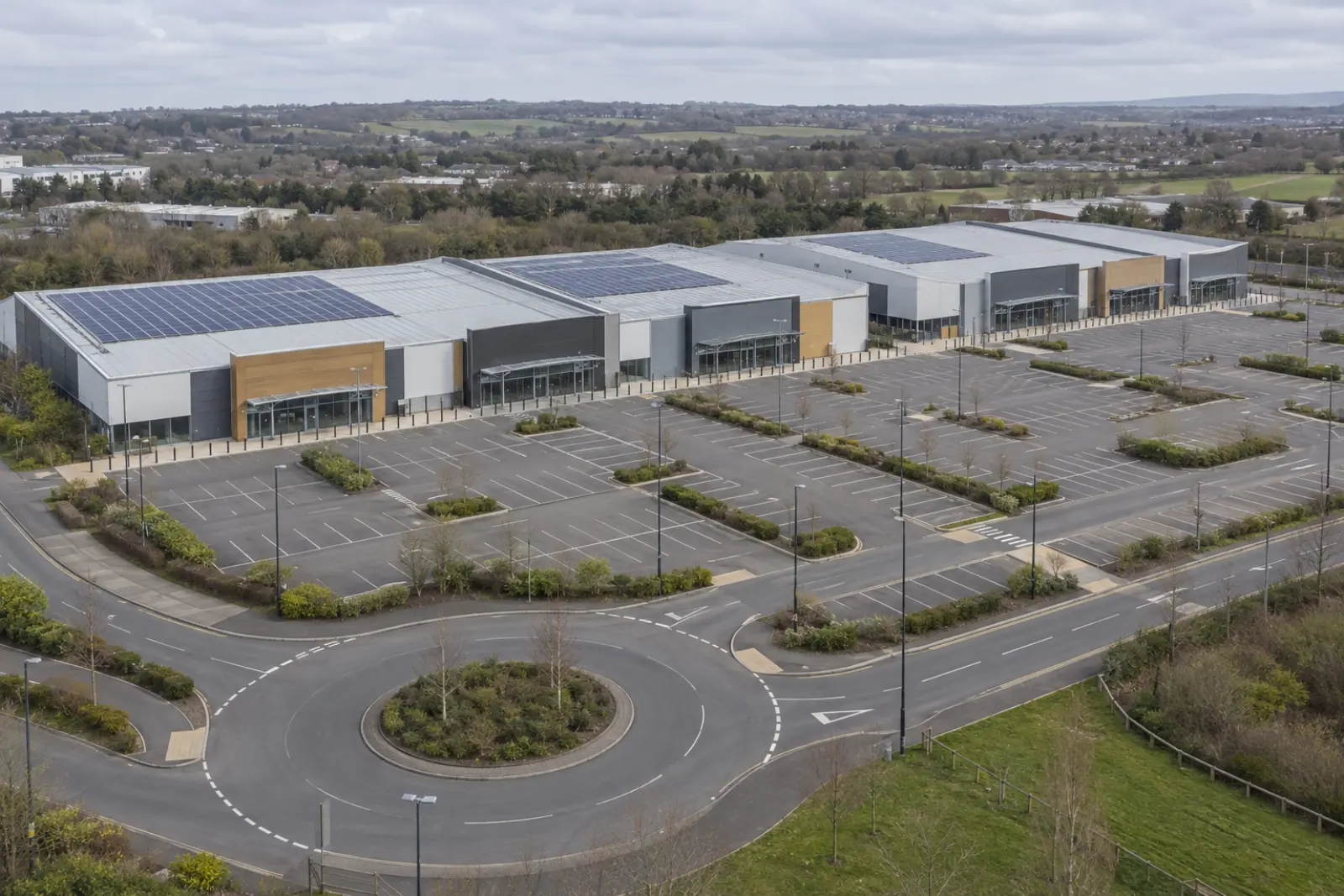
Which structures work for solar panels on a leased commercial building?
There are four workable structures for solar panels on a leased commercial building, and they differ on four questions: who funds, who owns the kit, who gets the savings, and what documents are needed.
1. Landlord funds and sells the power to the tenant
The landlord pays for the array as an improvement to its property and either sells the units to the tenant under an electricity supply agreement at a rate per kWh, usually set below the tenant's grid rate, or recovers the cost through the service charge. The landlord keeps the asset, the EPC gain and any export income. The supply agreement route is cleaner: the tenant pays for what it uses, on a meter. The service charge route works only if the service charge clause clearly covers installing new plant, and many clauses are drafted around repair and maintenance rather than improvements, so read the wording before relying on it. The RICS professional standard on service charges in commercial property, second edition, effective from 31 December 2025, governs how those charges are administered and reported. Selling electricity is also a regulated activity, covered below under multi-let buildings. On tax, HMRC treats solar PV as special rate expenditure (Capital Allowances Manual CA22335), so full expensing does not apply. Plant for leasing is generally excluded from first-year allowances, with a narrow exception for background plant in a building let under an excluded lease (CA23174ac), so a landlord should ask its accountant what it can claim rather than assume.
2. Tenant funds under a licence for alterations
The tenant pays, owns the array as a tenant's alteration and keeps the whole saving. The document is a licence for alterations, and it carries most of the risk: it should say who owns the kit, who insures it, who repairs the roof beneath it, whether it must be removed at lease end or may be left, and on what terms the landlord can require it to be lifted for roof works. In England and Wales, where the lease permits improvements with consent, section 19(2) of the Landlord and Tenant Act 1927 means that consent cannot be unreasonably withheld, although the landlord may require a reasonable undertaking to reinstate and its proper costs. This route fits a long unexpired term and a tenant with a heavy daytime load.
3. Third-party funder under a roof lease plus a PPA
A funder pays for and owns the array. The landlord grants the funder a roof lease, typically matched to the life of the system, sometimes for a roof rent. The funder sells the output to the occupier under a power purchase agreement at a rate per kWh, and sells any surplus to the grid. No capital comes from either landlord or tenant, and the capital allowances sit with the funder as owner of the array, not with the landlord or the occupier. The price is that three parties must agree, and the PPA has to survive a change of tenant, so the funder will ask what happens if the occupier leaves: whether the next tenant must take the PPA, whether the landlord steps in, or whether the funder can sell the power elsewhere. A roof lease longer than seven years of registered land must be registered at HM Land Registry, and it will show up on any sale or refinancing of the building.
4. Multi-let buildings: metering and private wire
One array on a multi-let office building or retail park cannot sit behind a single tenant's meter and serve everyone. The owner or a funder runs a private wire from the array to each occupier's unit and to the landlord's common parts supply, with a meter at each point, and bills each occupier for the units its meter records. The common parts load is often the easiest first customer, because the landlord already pays that bill and recovers it through the service charge. Fire separation matters on a multi-let roof too: RC62 (2023), the insurers' recommendations for PV on commercial buildings, allows a reduced 1.2 m separation from compartment walls where the risk is low, and names town-centre retail and offices among those cases. On a parade of units that affects how much of the roof one array can use.
electricity money legal right or consent
The four structures compared
| Structure | Who funds | Who owns the kit | Who gets the savings | Documents needed | EPC effect |
|---|---|---|---|---|---|
| 1. Landlord funds, sells or recharges the power | Landlord | Landlord, as part of the building | Shared: tenant buys below its grid rate, landlord earns on the units | Electricity supply agreement, or service charge provisions that clearly cover it; lease variation for access and metering | Landlord's EPC improves; landlord controls it |
| 2. Tenant funds under a licence for alterations | Tenant | Tenant, as a tenant's alteration | Tenant, in full, for as long as it stays | Licence for alterations with reinstatement, removal, insurance and roof repair terms | Building's EPC improves, but the kit may leave with the tenant |
| 3. Third-party funder: roof lease and PPA | Funder | Funder, for the term | Tenant, on the gap between the PPA rate and its grid rate | Roof lease from landlord to funder; PPA between funder and occupier; landlord consent and step-in terms | Building's EPC improves while the array stays |
| 4. Multi-let building, private wire to several occupiers | Landlord or funder | Landlord or funder | Split across occupiers by metered use, and the common parts | Supply agreement with each occupier, metering schedule, licence or exemption position, service charge treatment | Depends how the building is divided for EPC purposes |
General market positions for commercial property in England and Wales. The lease and the documents in front of you govern, not this table.
- The unexpired term, with a realistic renewal, covers the payback comfortably
- The daytime load is high and the tenant wants the whole saving
- The landlord will consent but has no appetite to invest
- Reinstatement and removal terms are agreed in writing before the works
- A break or expiry falls well inside the payback period
- The roof covering needs replacing within the life of the array
- The building is multi-let, so one array serves several occupiers
- The landlord needs the EPC gain to hold for future lettings and the MEES trajectory
Can a landlord supply electricity to tenants on site?
Under the Electricity Act 1989 it is an offence to supply electricity to premises without a licence unless an exemption applies, so any structure in which a landlord or a funder sells units to an occupier has to sit within a licence exemption.
The exemptions for supply are in Schedule 4 of the Electricity (Class Exemptions from the Requirement for a Licence) Order 2001. They include a small supplier class for generators supplying their own output within a power limit, an on-site supply class, and a resale class. Class exemptions apply automatically where their conditions are met: there is no application to Ofgem or to government, and nobody checks on your behalf. The government's licence exemption guidance says plainly that the department cannot advise whether an individual arrangement qualifies, and that anyone unsure should take legal advice.
In practice that means three things for a multi-let building. Decide early who the supplier of the solar units is, the landlord, a funder or a licensed supplier engaged to provide the service. Put a proper meter at every point of sale, because the bill has to follow the meter. And have the solicitor confirm the exemption position before the first invoice, not after. A private network within the building may raise distribution questions too, which are covered by a separate schedule of the same Order. Distribution and supply exemptions are technical, and this page deliberately keeps to the general position.
The array itself still connects to the public network in the normal way. Above 3.68 kW per phase that is a G99 application to the local network operator, which on a multi-let building is made against the landlord's supply rather than any one tenant's.
Lease term against a 25-year asset: where the dates collide
A rooftop array is planned over decades, while occupational leases of commercial property are often shorter and carry breaks, so the structure has to survive the lease ending before the array does.
Three dates matter. The break or expiry of the occupational lease, because a tenant-funded array needs its payback inside the term it can rely on. The remaining life of the roof covering, because re-covering under an array means lifting and relaying it, and someone has to pay for that. And the length of any roof lease to a funder, which is usually set to match the array rather than any occupational lease. Fig. 2 draws those horizons on one axis. The lease and roof lengths are illustrative, not typical values.
Which lease provisions matter for a rooftop array?
Eight lease provisions decide whether a rooftop array works on let commercial property, and each should be settled in the lease, the licence for alterations or the roof lease before any panel goes up.
- Alterations and the demise. Does the tenant's demise include the roof? If not, the tenant needs rights over it as well as consent. Is the alterations covenant absolute or qualified? The BBP toolkit has clauses that widen a tenant's ability to make alterations that improve environmental performance or the EPC rating.
- Access. The array owner needs access for maintenance, inverter replacement and cleaning, and the other party needs access to the roof for its own repairs. Hours, notice, safety and supervision all belong in writing.
- Asbestos. On let buildings the lease usually decides who holds the duty to manage asbestos under regulation 4 of the Control of Asbestos Regulations 2012. Whoever holds it must be satisfied before anyone drills or fixes into an older roof.
- Insurance. Who insures the array, who insures the building against damage caused by it, and whether the landlord's buildings policy needs the insurer told. Fire strategy on the roof is part of this conversation.
- Repair and roof replacement. Who repairs the roof under the array, who pays to lift and relay the panels for roof works, and whether that cost can go through the service charge. This is the provision most often left out.
- Term, breaks and assignment. What happens to the array, and to any PPA, on a break, an expiry, an assignment of the lease or a sale of the building. A funder will not lend against a roof it can lose on six months' notice.
- Data sharing and metering. Both sides need the generation and consumption figures, the landlord for its EPC, ESG reporting and portfolio sustainability goals, the tenant for its own. The BBP toolkit's data sharing clauses cover energy, water and waste data at agreed intervals, with confidentiality protections.
- Reinstatement and MEES cooperation. Whether the array must be removed at the end, handed over, or left in place, and a cooperation clause obliging the tenant to allow works that keep the building lettable under Minimum Energy Efficiency Standards. The BBP's yield up clause asks the landlord to have due regard to the environmental impact before requiring reinstatement, while keeping its right to insist where re-letting needs it.
What should a tenant ask the landlord before solar goes on the roof?
A tenant considering solar on a leased building should put a short set of written questions to the landlord or its managing agent before paying for a design.
- Is the roof part of our demise, and if not, will you grant rights over it for the array?
- Will you consent to the works, and what will the licence for alterations say about reinstatement and removal?
- When is the roof covering due for replacement, and who pays to lift and relay the array if it is?
- Would you rather fund the array yourself and sell us the power, or let a funder take a roof lease?
- If we break or leave, can the array stay, and on what terms would you or the next tenant take it over?
- How will the generation data be shared, and will it count toward the building's EPC and your reporting?
- Is the building multi-let, and if so who else would buy the power and how would it be metered?
A landlord should put the mirror image to its tenant: how long it expects to stay, how much of its load falls in daylight hours, and whether it will sign a supply agreement or a PPA. Both sets of answers are what the survey and the funding comparison are built on. The same questions apply across sectors, to an office, a hotel, a leisure centre or a car dealership; only the load profile changes.
The answers also shape the cost, because a structure that needs roof works first or a private wire across several units is a different job from a single-let roof. What drives those numbers is set out on the cost page, and the calculator gives a first view of what the roof might carry.
What we arrange, and what this page is not
Lenzie Consulting Ltd arranges the roof survey, the design, the grid application and the installation through an MCS-certified partner, and puts funders in front of landlords and tenants where a roof lease and PPA is the better route. On a let building we work with landlords and tenants, managing agents and real estate investment managers, whichever side holds the roof, and we expect both solicitors to be involved.
This page is general information about green leases and commercial property, not legal advice. The lease, the licence and the supply arrangements for your building should be drafted or reviewed by your own solicitor.
Book a roof survey for a let building
Tell us the postcode, whether you are the landlord or the tenant, and roughly how the building is let. We come back with what the roof can carry, how the output lines up with the occupiers' consumption, and which of the four structures fits the lease.
No survey fee and no obligation to proceed. We pass your details to our MCS-certified installation partner and, where relevant, to funders so they can quote.
Questions about green leases and solar on let property
- What is a green lease?
- A green lease is a lease of commercial property that includes clauses committing the landlord and the tenant to cooperate on the environmental performance of the building: sharing energy data, managing the building sustainably, allowing works that improve efficiency, and dealing with EPCs, waste and renewable energy. In the UK the reference drafting is the Better Buildings Partnership Green Lease Toolkit, updated in January 2024. The term covers anything from a single cooperation clause to binding obligations with measurable targets.
- What are green lease clauses?
- Green lease clauses are the individual lease provisions that make a lease green. The BBP toolkit publishes model green clauses in around twenty areas, including cooperation, a building management group, data sharing, metering, the landlord's right to do works, tenant alterations, EPCs, waste, yield up, circular economy, service charge and renewable energy. For most of them it offers light, medium and dark green drafting, so parties can choose how binding each commitment is.
- What is the BBP Green Lease Toolkit?
- The BBP Green Lease Toolkit is a free set of model clauses, drafting guidance, heads of terms guidance and case studies published by the Better Buildings Partnership, a collaboration of UK commercial property owners. The first version dates from 2008 and the current edition was published on 29 January 2024. It also sets out Green Lease Essentials: ten areas the BBP would expect a lease to cover before calling it green.
- What are the three types of green lease clause?
- The three types in the BBP toolkit are light, medium and dark green drafting. Light green clauses are largely cooperative and aspirational. Medium green clauses turn cooperation into practical obligations. Dark green clauses are the most demanding, binding one or both parties to specific outcomes. On renewable energy, for example, the light green clause asks for a green tariff where one is available at a commercially reasonable rate, while the dark green clause looks first to on-site generation, then a PPA, then a green supplier.
- Can a tenant put solar panels on a leased commercial building?
- A tenant can put solar panels on a leased commercial building if the lease gives it the roof or allows the works with consent, and the landlord grants a licence for alterations. Many occupational leases exclude the roof and airspace from the demise, in which case the tenant also needs rights over the roof. In England and Wales, where the lease allows improvements with consent, section 19(2) of the Landlord and Tenant Act 1927 says that consent is not to be unreasonably withheld, though the landlord can ask for a reasonable reinstatement undertaking and its costs.
- Who owns solar panels on a rented commercial building?
- Ownership of solar panels on a rented commercial building follows the documents that put them there, and it should never be left to assumption. If the landlord funds the array it is landlord's plant. If the tenant funds it under a licence for alterations it is a tenant's alteration, removable or left behind as the licence says. If a third-party funder pays, it owns the array for the term of its roof lease and sells the output under a PPA. Ownership should be written down, because fixtures law alone is a poor way to settle it at lease end.
- Can a landlord sell solar electricity to tenants?
- A landlord can sell solar electricity to tenants, but selling electricity to premises is a licensable activity under the Electricity Act 1989, so the landlord either holds a supply licence or falls within an exemption. Class exemptions under the Electricity (Class Exemptions from the Requirement for a Licence) Order 2001 apply automatically where their conditions are met, with no application to Ofgem or the government. DESNZ does not advise on individual cases and recommends legal advice, so the landlord's solicitor should confirm the position before the first bill.
- Does solar help a let building meet MEES?
- Solar can help, because a non-domestic EPC is an asset rating modelled in SBEM and on-site renewable generation forms part of that calculation. How far it moves the rating depends on the building. Since April 2023 a non-domestic building in England and Wales cannot continue to be let below EPC E without a registered exemption, and the government's June 2026 interim response points to EPC B by 2031 for let buildings over 1,000 m2, where cost effective.
- What happens to the panels when the lease ends?
- What happens to the panels at lease end is whatever the licence for alterations, the yield up clause or the roof lease says. The usual options are removal with the roof made good, handing the system over to the landlord, or keeping it in place under a new arrangement with the next occupier. The BBP toolkit's yield up clause asks the landlord to have due regard to the loss of environmental performance before requiring removal, while preserving its right to insist where re-use or re-letting needs it. Agree it before the works, not at dilapidations.