Grants for solar panels on commercial buildings: an honest map
There is no national grant for rooftop solar on a commercial building in England, and any page that tells you otherwise should name the scheme and the closing date. What genuinely reduces the cost for owners, landlords and tenants of offices, shops, hotels, leisure centres and dealerships is tax relief, a business rates exemption and export income. This page sets out each one, who can use it and where the rule comes from, checked on 22 September 2026.
Contents
Is there a government grant for solar panels on commercial buildings?
No. A commercial solar grant, meaning public money paid to a private business towards panels on its own building, does not exist as a national scheme in England as at September 2026.
The Feed-in Tariff closed to new applicants on 31 March 2019, and its successor, the Smart Export Guarantee, pays for exported electricity rather than towards installation. The Boiler Upgrade Scheme funds heat pumps, not solar PV. The Industrial Energy Transformation Fund was aimed at industrial process energy, not at offices or retail units, and gov.uk's own find funding to help your business become greener page was last updated on 26 October 2022, which tells you how quiet this area has been.
The grants that did exist for business solar were local. Councils used UK Shared Prosperity Fund money (the UKSPF) for small business decarbonisation grants, and those allocations run out on 30 September 2026. The public sector's main scheme, the Public Sector Decarbonisation Scheme, stopped taking new investment in June 2025. Both are covered further down.
Businesses usually arrive at this page for one of two reasons: energy costs that have risen faster than any other overhead, or a net zero or low carbon commitment with a date attached. Both are good reasons to put commercial solar on a roof, and neither is helped by waiting for business grants that do not exist. So the useful question is not "which grant can I get" but "what reduces the net cost of the array for my kind of organisation". The answer depends mostly on two things: whether you are a company, and whether you own the building or rent it. The table gives the short answer.
Who qualifies for what
| You are | Capital allowances | Business rates exemption | Smart Export Guarantee | Local business grants | Public sector funding | PPA or roof lease |
|---|---|---|---|---|---|---|
| Owner-occupier company a hotel group, a dealer principal's own showroom, an office HQ | Yes: AIA to £1m, then 50% FYA, then 6% pool | Yes, as ratepayer | Yes, on export | Only if one is open locally | No | Yes, funder claims the allowances |
| Landlord investor or asset manager owning let retail, office or leisure stock | Yes if the landlord pays; 50% FYA leasing exclusion needs advice | Benefit goes to whoever pays the rates, usually the tenant | Yes, if the landlord holds the export contract | Rarely; most were for SME occupiers | No | Yes, often the cleanest structure |
| Tenant a retailer, gym operator or office occupier on a lease | Usually, if the tenant pays for the fixtures for its trade | Yes, as ratepayer | Yes, if the tenant holds the export contract | Only if one is open locally | No | Only with landlord consent |
| Sole trader or partnership an independent shop, a family-run hotel | AIA to £1m; no 50% FYA, which is for companies | Yes, as ratepayer | Yes, on export | Only if one is open locally | No | Yes |
| Public body a council that owns a leisure centre, library or civic office | Not relevant: no corporation tax | Yes, where the building is rated | Yes, on export | Not the route | PSDS closed to new bids; GB Energy funds; Salix loans in Wales and Scotland | Yes, subject to procurement |
A summary, not tax advice. Allowances depend on who incurs the expenditure and on the company's own position; confirm with your accountant before you rely on any cell.
- in force, open to new arrays
- closed to new applicants or closing
- no end date set
How do capital allowances reduce the cost of commercial solar panels?
Capital allowances are the tax relief a business gets on plant and machinery. HMRC designates all capital expenditure on solar panels as special rate expenditure, from 1 April 2012 for corporation tax and 6 April 2012 for income tax.
That designation decides which allowances apply. Solar panels do not qualify for full expensing, which is the 100% first-year allowance for main rate plant. They sit in the special rate pool alongside integral features such as lighting, lifts and air conditioning. There are three ways the spend can be relieved, and the order matters.
The Annual Investment Allowance comes first
The Annual Investment Allowance (AIA) gives a 100% deduction in the year of spend on up to £1 million of qualifying plant and machinery. HMRC's manual confirms it can be claimed on integral features and other special rate expenditure, and that a business can allocate it to whichever expenditure it chooses, which usually means the spend that would otherwise get the slowest relief. Solar is an obvious candidate. Limited companies, sole traders and partnerships whose members are all individuals can claim it; a group of related companies shares one AIA.
Companies then use the 50% first-year allowance
Beyond the AIA, a company can claim the 50% first-year allowance on new and unused special rate plant bought from 1 April 2023. Half the cost comes off taxable profits in the year of purchase and the balance goes into the special rate pool from the following period. This relief sits alongside full expensing, and both were made permanent. It is for companies only, and it excludes plant bought to lease to someone else, with an exception for background plant and machinery in a building let under an excluded lease (HMRC CA23174AC). Whether a rooftop array a landlord installs falls inside that exception is a question for your tax adviser, not for a sales page.
Everything else writes down at 6%
Whatever is not covered by the AIA or the 50% allowance is written down at 6% a year on the reducing balance. The 40% first-year allowance introduced from 1 January 2026 does not help here: it applies to main rate expenditure only, and gov.uk states that the special rate pool stays at 6%. The main pool rate fell from 18% to 14% from April 2026; that change does not touch solar either.
Fig. 2 shows what those rules mean per £100 of solar spend. The difference between a company and a partnership that has used its AIA is large, and it is one reason the same array can pay back on different timescales for two businesses in the same retail park.
- deducted in the period of spend
- cumulative deduction after five periods
One practical consequence: the allowances follow whoever incurs the expenditure. If you buy outright, or with a loan or hire purchase, the claim is normally yours. Under a power purchase agreement or a roof lease, the funder owns the panels, claims the allowances and prices that into the rate it charges you. A tenant that pays for fixtures for the purposes of its own trade can usually claim under the fixtures rules, but the lease and any contribution from the landlord change that, so get the structure agreed before the order is placed. The trade-offs between routes are on our cost page.
Does rooftop solar increase business rates in England and Wales?
No, not until 2035. The renewables plant and machinery exemption is a business rates measure that removes eligible on-site generation and storage equipment from rateable value.
Before it, a building that installed rooftop solar for its own use could see its rateable value rise, while generators selling power off site already benefited from the "tools of the trade" exemption. The government's business rates review concluded that this penalised on-site renewable energy, and the exemption followed. In England it was brought into force from 1 April 2022, a year earlier than first announced, and runs until 31 March 2035. It covers plant and machinery used for the generation, storage, transformation or transmission of power where the source is mainly or exclusively renewable, photovoltaics included, and storage for EV charging points.
There is no application form. The explanatory memorandum states that the Valuation Office Agency removes the eligible items from rateable values and councils reissue the bills.
Wales made its own regulations, which apply the same exemption from 1 April 2024 to 31 March 2035. Scotland sets its own non-domestic rates rules; check with the local assessor before assuming the same treatment.
For businesses weighing the running costs of an array, this removes what used to be a real disincentive. The exemption helps whoever pays the rates. On a let building that is usually the tenant, which is one more reason landlords and tenants should agree how the benefits of an array are shared. The landlords page covers the lease side and the MEES page covers what an array can do for the EPC.
What does the Smart Export Guarantee pay a commercial building?
The Smart Export Guarantee (SEG) is an Ofgem-administered obligation on larger electricity suppliers to offer a tariff for renewable energy exported to the grid from installations up to 5 MW in Great Britain.
Suppliers with at least 150,000 domestic customers must offer at least one SEG tariff; others may choose to. The rate is set by the supplier and must always be above zero, so there is no single national figure and you can switch supplier for a better export rate. To be paid you need an export meter capable of half hourly readings and an export MPAN. For solar PV up to 50 kW, the supplier will ask for evidence that the installation and installer are certified under MCS or an equivalent scheme.
On most commercial buildings the export income is the smaller part of the value. Units you use on site displace electricity you would otherwise buy at the full import price; units you export earn a lower rate. The SEG improves a good scheme and rarely rescues a poor one. It does not apply in Northern Ireland, which is outside the Great Britain scheme.
Are there local authority or combined authority grants for business solar?
Sometimes, briefly, and mostly for small businesses. Local business grants for decarbonisation are the one place a private company has found real grant funding towards solar panels, and they follow a recognisable pattern.
Most were funded by the UK Shared Prosperity Fund and run by a council or combined authority, often through the local growth hub. A typical scheme paid a share of the project cost after the business had paid for the work in full, capped the award, required a period of trading, and closed when the money ran out. Nottingham City Council's 2025-26 Business Decarbonisation Grant is a fair example: it listed solar panels as eligible alongside energy efficiency measures such as LED lighting, paid 50% of project cost excluding VAT up to £10,000 (with discretion to £15,000), reimbursed after the business had funded 100% upfront, and required all claims by 6 March 2026. It is closed.
That pattern matters because the UK Shared Prosperity Fund itself is ending. The government's 2025-26 guidance says no funding will be provided for activity after 30 September 2026. Many of the regional grant lists still ranking for commercial solar grants describe schemes funded this way. We could not verify any council or combined authority grant for solar on commercial buildings that is open to new applications as at 22 September 2026, so we name none.
How to check your own area
- Your council's business support pages. Search for "business decarbonisation grant" or "net zero business grant" with your council name, and read the closing date and claim deadline, not just the headline.
- Your local growth hub. It will know whether a combined authority scheme is planned for 2026-27 and who administers it.
- The order of events. Most schemes will not fund work already ordered, so apply before you sign an installation contract.
- Size. A £10,000 cap is meaningful on a small shop roof and marginal on a retail park unit or hotel, so do not let a small grant set the design of a large system.
What funding is left for leisure centres and other public buildings?
The Public Sector Decarbonisation Scheme (PSDS), delivered by Salix Finance, was the main grant route for public buildings in England. It is closed to new investment.
On 12 June 2025 Salix announced that government "has taken the difficult decision to commit no further investment for the Public Sector Decarbonisation Scheme beyond currently awarded projects". Phase 3c grant funding ran to 31 March 2026 and phase 4 runs to 31 March 2028, for projects already awarded. A council planning solar on a leisure centre or civic office now cannot bid into a new phase.
Great British Energy has become the main source of public money for rooftop solar on public buildings. It opened a £20 million Community Fund and a £5 million Partnerships Grant on 17 September 2026 for community organisations and local authorities in England, Wales and Northern Ireland, as the first tranche of its Local Power Plan. Projects must give the community a defined legal and financial interest in the asset. Separately, it has provided up to £16 million to the mayoral combined authorities in England, and gov.uk reports 157 rooftop solar projects installed on public buildings from fire stations to leisure centres; that money is allocated to the authorities, not applied for by an individual building.
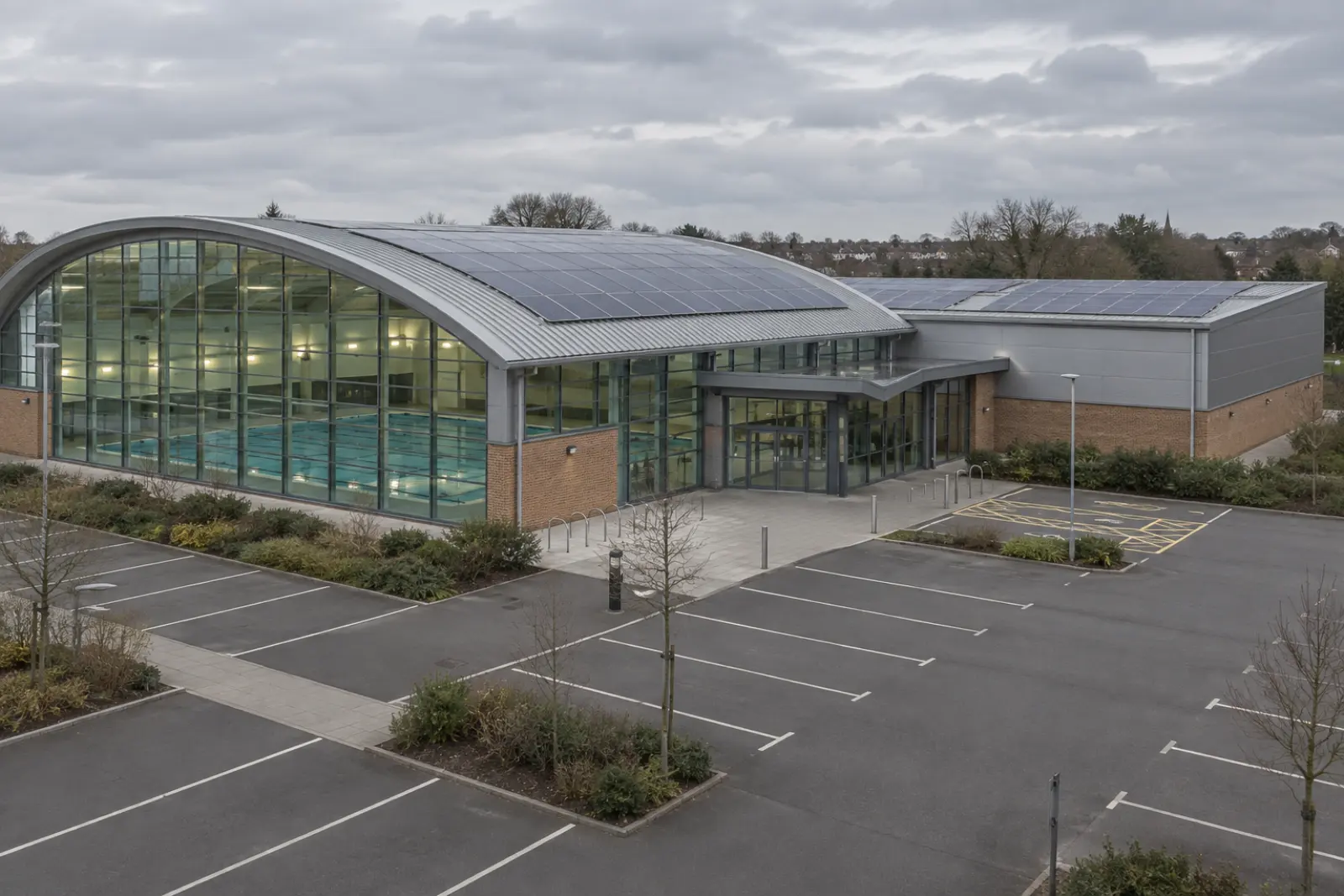
For a council, the case for commercial solar on a leisure centre is usually strong on its own terms: pool plant, ventilation and lighting run all day, so most generation is used on site, which cuts both energy costs and carbon emissions from the estate. Two practical points for civic buildings. Many leisure centres are owned by the council but operated by a trust or contractor, so decide early who owns the array, who pays the energy bill and who holds the export contract. And any funding route needs a costed, surveyed design, which takes longer to produce than most windows stay open.
What business energy support exists in Scotland and Wales?
Both nations run their own green business energy loans rather than solar grants, and Salix runs separate public sector programmes in each.
Scotland
The SME Loan Scheme, run by Business Energy Scotland for the Scottish Government, offers interest-free loans with cashback for energy efficiency and renewable heat. Business Energy Scotland's own FAQs state that the scheme is not accepting new applications for solar PV projects. A Scottish business looking for help with a PV array should not plan around it. For public bodies, Salix lists the Scottish Public Sector Energy Efficiency Loan Scheme and the Scotland Recycling Fund as open.
Wales
The Green Business Loan Scheme, from the Development Bank of Wales with Business Wales, lists solar PV among eligible projects. It is open to limited companies, sole traders and partnerships based in Wales that have traded for at least two years with filed accounts, and offers discounted fixed interest rates plus part-funded energy consultancy. These are loans, repayable with interest, not renewable energy grants. For public bodies, Salix lists the Wales Funding Programme, which provides loan funding for decarbonisation projects, as open.
Are free solar panels for commercial buildings really free?
Free commercial solar is a financing structure, not a grant. It is usually a power purchase agreement (PPA) or a roof lease.
Under a PPA, a funder pays for, owns and maintains the array, and the building buys the electricity at an agreed rate for a long term. Under a roof lease, the funder rents the roof and the building may or may not buy the power. Either way there is no capital cost, and either way the funder keeps what a buyer would have had: the capital allowances, the export income and the asset. For a landlord that wants to improve a building without spending capital, or a tenant with a short lease who cannot justify the purchase, that trade can make sense. For an owner-occupier company with the tax capacity to use the AIA or the 50% allowance, buying usually leaves more value in the business.
The questions to ask are the same whatever the marketing says: what rate per unit, how it escalates, how long the term is, what happens when the building is sold or re-let, who removes the array at the end, and whether you can switch to buying the power elsewhere if the rate stops being competitive. The landlords page sets out how these structures work on let property.
How we price a scheme when there is no grant to wait for
Because the support that matters is tax relief, rates and export income rather than an award, there is nothing to wait for. We arrange a roof survey through an MCS-certified partner, establish what the roof can carry once plant, access and edge zones are allowed for, and model generation against your half hourly consumption. You get a capital cost, a split between energy used on site and energy exported, and the figures your accountant needs to confirm the allowances. If a grant does open in your area, that same survey is what the application will ask for.
Lenzie Consulting Ltd arranges the survey, the design and the installation through an MCS-certified partner. We do not give tax, financial or legal advice; take your own before committing.
Find out what the roof is worth with the support that exists
Send the postcode and a rough roof size. We come back with what the roof could carry and generate against your consumption, and how the allowances and rates exemption change the numbers for your kind of organisation.
No survey fee and no obligation to proceed.
Questions about commercial solar panel grants
- Are there any solar panel grants available in the UK in 2026?
- For a private business with a commercial building in England, not nationally. As at 22 September 2026 there is no national grant scheme that pays a company towards solar panels on its own offices, shops, hotel or leisure building. Council grants funded by the UK Shared Prosperity Fund did cover solar in some areas, but the 2025-26 allocations can only fund activity on or before 30 September 2026 (gov.uk, UKSPF 2025-26 additional information, published 17 December 2025). What remains is tax relief through capital allowances, the business rates exemption for renewables plant and machinery, Smart Export Guarantee income, and public or community funding that a private company cannot apply for.
- Who is eligible for solar panel grants?
- In practice, public bodies and community organisations rather than private companies. The Great British Energy funds opened on 17 September 2026 are for community organisations and local authorities (gov.uk, 17 September 2026). Salix Finance runs public sector loan schemes in Wales and Scotland. A trading company is eligible for capital allowances, the business rates exemption and the Smart Export Guarantee, none of which requires an application to a grant body.
- Are commercial solar panels worth it?
- They are worth it when the building uses most of what the roof generates while the sun is up. A unit consumed on site displaces the full price you pay to import, while a unit exported earns only the Smart Export Guarantee rate your supplier offers, which is lower. Supermarkets with refrigeration, hotels, leisure centres with pool plant and offices with daytime cooling usually use a high share of their generation. A building that is empty at weekends exports more and the case is weaker. We model your half hourly consumption against the roof before anyone quotes, and say so if the answer is no. The numbers are on our cost page.
- What is the 20% rule for solar panels?
- There is no 20% rule in UK law or regulation for solar panels on commercial buildings. The phrase is used loosely online, usually for a sizing rule of thumb, and it does not appear in the planning rules, the grid connection rules or HMRC guidance. The thresholds that do matter are these: rooftop solar on non-domestic buildings in England is permitted development under Class J, subject to limits on projection and distance from the roof edge, and a system above the 50 kW microgeneration line needs a prior approval determination from the council on design, appearance and glare before work starts; systems above 3.68 kW per phase connect under G99 through the local network operator; and the Smart Export Guarantee applies up to 5 MW.
- Can I get free solar panels for a commercial building?
- Not as a grant. What is marketed as free commercial solar is almost always a power purchase agreement or a roof lease: a funder pays for and owns the array, and you buy the electricity it generates at an agreed rate, or you rent them the roof. There is no capital cost, but the funder takes the capital allowances and the export income, and you sign a long contract that ties up the roof. It can be the right answer, particularly on let property. Our landlords page explains the structures.
- Do solar panels increase business rates?
- Not in England or Wales at present. Plant and machinery used for generating or storing renewable power is excluded from rateable value in England from 1 April 2022 and in Wales from 1 April 2024, in both cases until 31 March 2035 (SI 2022/405; WSI 2023/1229). The VOA applies the exemption; there is nothing to apply for. It is a temporary measure, so the position after March 2035 depends on future legislation.
- Can a leisure centre get a grant for solar panels?
- A council-owned leisure centre is more likely to find funding than a private gym, but the main scheme in England has closed to new applicants. Salix confirmed on 12 June 2025 that government would commit no further investment to the Public Sector Decarbonisation Scheme beyond awarded projects. Great British Energy has since funded rooftop solar on public buildings through mayoral strategic authorities and opened community and local authority funds on 17 September 2026. A privately operated gym or health club is treated like any other business.
- Is there a solar grant for businesses in Scotland or Wales?
- Not a grant for solar PV. In Scotland, Business Energy Scotland states that its SME Loan Scheme is not accepting new applications for solar PV projects (checked September 2026). In Wales, the Development Bank of Wales Green Business Loan Scheme lists solar PV among eligible projects, with discounted fixed interest rates for businesses based in Wales that have traded for at least two years. That is a loan, repayable with interest, not a grant.