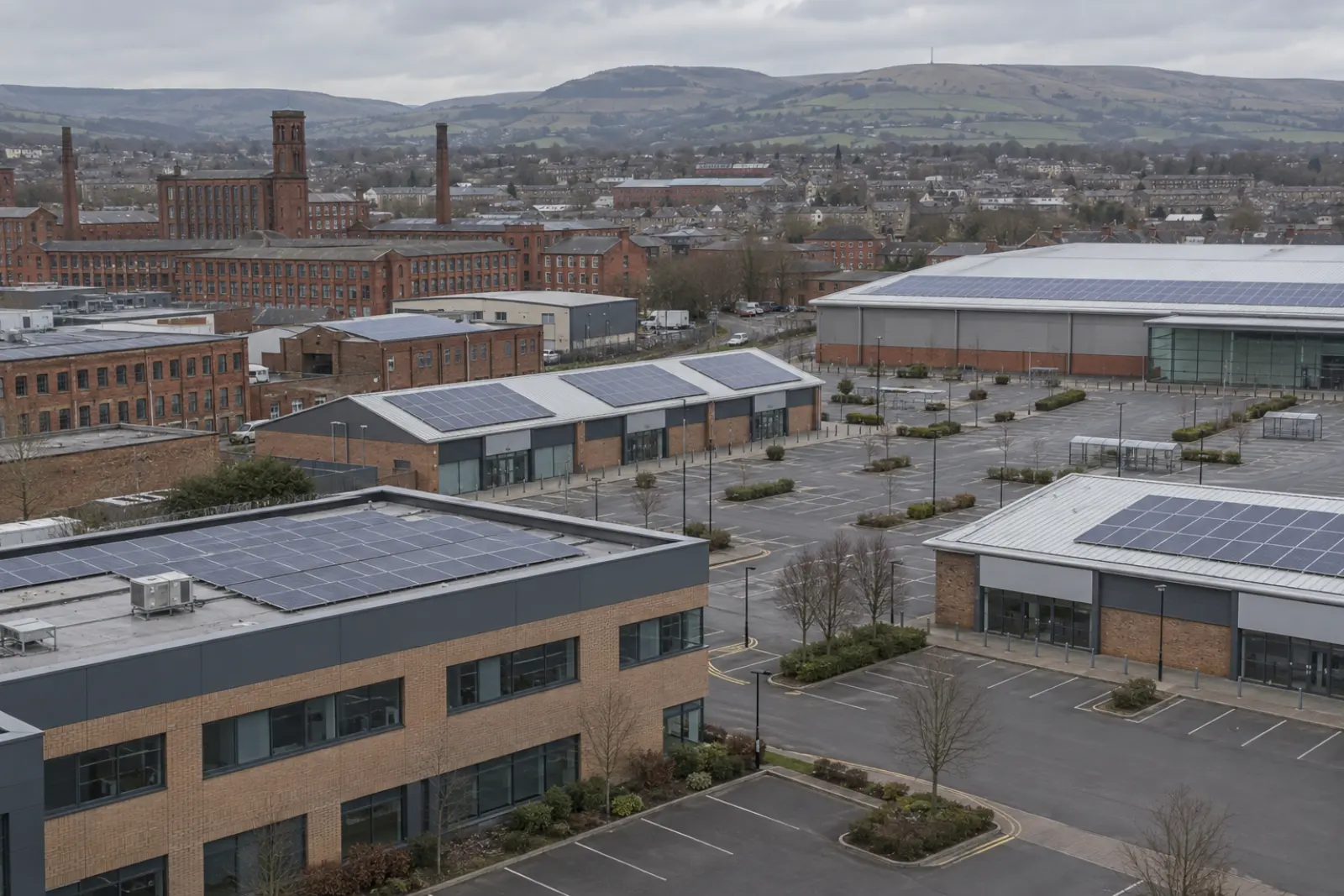
Commercial building solar panels in Liverpool
For a landlord in Liverpool, a roof array is increasingly a question about the EPC rating as much as the electricity bill. Each survey records the usable area once edge strips, plant and walkways are taken out, the load the deck can take, and whether the lease lets the occupier alter the roof.
848 kWh per kWp a year at this latitude, so a 210 kWp array models at about 178,000 kWh. Source: EU PVGIS v5.2, SARAH3, 10 degree pitch, 14 percent system loss.
Book a roof survey in LiverpoolIllustrative layout for a flat commercial roof of this size, with plant, shade and access kept clear. Your own figures come from the roof survey.
- 506,565
- people in the Liverpool built-up area (ONS Census 2021)
- 4,460
- office properties on the rating list in Liverpool (VOA, March 2025)
- 5,560
- retail properties, 200 of them large-format (VOA, March 2025)
- 0
- named commercial rooftop schemes on the planning record nearby (REPD, Q1 2026)
Solar for offices and retail across Merseyside
How much sun a Liverpool roof gets
Modelled irradiation here is 1,083 kWh per square metre a year on a low-tilt array, which works out at 848 kWh for every kWp installed (EU PVGIS v5.2, SARAH3, 10 degree pitch, 14 percent system loss). That is about 4 percent below the mean across the towns we cover, so the case here rests more on daytime consumption than on raw generation.
The rating list for Liverpool
The Valuation Office Agency's rating list puts 4,460 office and 5,560 retail properties in Liverpool, covering about 901,000 and 1,140,000 square metres of floorspace respectively. By office stock the district sits in the top tenth of the 318 districts in England and Wales; by retail stock it sits in the top tenth of the 318 districts in England and Wales.
200 of those retail properties are superstores, large food stores, large shops or retail warehouses, together about 486,000 square metres. Single storey boxes of that size are where most commercial rooftop solar actually gets built, because the roof is big, flat or shallow, and uninterrupted.
The same list carries 650 hotel, leisure and assembly properties in the district. Leisure centres and hotels run seven days a week, which puts weekend generation to use that an office would export.
Source: Valuation Office Agency, Non-domestic rating: business floorspace, 31 March 2025 (published December 2025), counts and floorspace by special category code and local authority district, England and Wales.
The built-up area holds about 506,565 people, a city-scale centre with office quarters, shopping centres and out-of-town retail parks (ONS Census 2021 built-up areas).
Surveys run across L postcodes, L13 outward.
Liverpool ranks 5 of 6 towns we cover in Merseyside on modelled yield, against a national mean of 886 kWh per kWp. The county runs from 830 to 877, a spread of 47 kWh per kWp. On a 210 kWp commercial roof that is about 9,870 kWh a year between the strongest and weakest town in the county.
All solar on record near L13
Every scheme in this postcode district in the government's Renewable Energy Planning Database, Q1 2026, ground and roof mounted, commercial or not. None of them is ours. Together they are a fair guide to how the local network has been treating export applications.
| Scheme | Operator | Capacity | Mounting | Status |
|---|---|---|---|---|
| The Big Yellow Self Storage, Mill Lane - Solar Panels | Big Yellow Group | 0.17 MW | Roof | Revised |
| The Big Yellow Self Storage, Mill Lane - Solar Array | Big Yellow Group Plc | 0.17 MW | Roof | Awaiting Construction |
| Stanley Meat Market, Prescot Road - Solar PV Systems | Selmar Properties | 0.3 MW | Roof | Awaiting Construction |
Grid connection through SP Energy Networks
SP Energy Networks operates the distribution network across Merseyside, so the export application goes to them. Anything larger than 3.68 kW per phase falls under G99, which means an application before commissioning rather than a notification afterwards. A constrained network is not the end of a scheme. Capping export costs little when the building already absorbs most of what the roof produces.
Across Merseyside the planning database records 104 solar schemes totalling 98 MW, of which 1 are operational (REPD Q1 2026).
Send us the postcode
Tell us where the building is, roughly how big the roof is, and whether you own it or lease it. We come back with what it can carry, what it would generate against your consumption, and the three ways to pay for it.
Lenzie Consulting Ltd arranges the survey and passes your details to our MCS-certified installation partner so they can quote.
Questions about solar in Liverpool
- What would a 210 kWp array produce in Liverpool?
- Yes. At 848 kWh per kWp a year, a 210 kWp array on a Liverpool roof models at around 178,000 kWh. What changes the answer is how much of that the building uses during opening hours rather than exports. Source: EU PVGIS v5.2, SARAH3, 10 degree pitch, 14 percent system loss.
- Is planning permission needed for panels on a Liverpool office or shop?
- Usually not a full application. In England, panels on the roof of a non-domestic building are permitted development under Class J of Part 14 of the General Permitted Development Order, with no capacity cap since December 2023. Above 50 kW, which covers most commercial arrays, you must first apply to Liverpool for a determination on prior approval of the design and appearance, in particular glare on neighbouring land. On a flat roof panels may stand no more than 1 metre above the roof and must sit at least 1 metre from its edge, and listed buildings and scheduled monuments are excluded. See our planning permission guide for the detail.
- Will rooftop solar improve the EPC rating of a let building in Liverpool?
- It can. A non-domestic EPC is an asset rating, and on-site generation counts in the calculation, so an array usually lifts the score. Let property in England and Wales must be EPC E or better today. The government's interim response of 18 June 2026 proposes EPC B, where cost effective, from 2031 for let buildings over 1,000 m², and drops the EPC C step once planned for 2027. How far solar moves a particular building depends on its fabric and services, which is why the EPC assessor models it before anything is fitted.
- Does the grid around Liverpool have capacity for export?
- SP Energy Networks is the distribution network operator for Merseyside. Arrays above 3.68 kW per phase connect under G99, and the application sets the export limit. It is part of the design work we arrange.